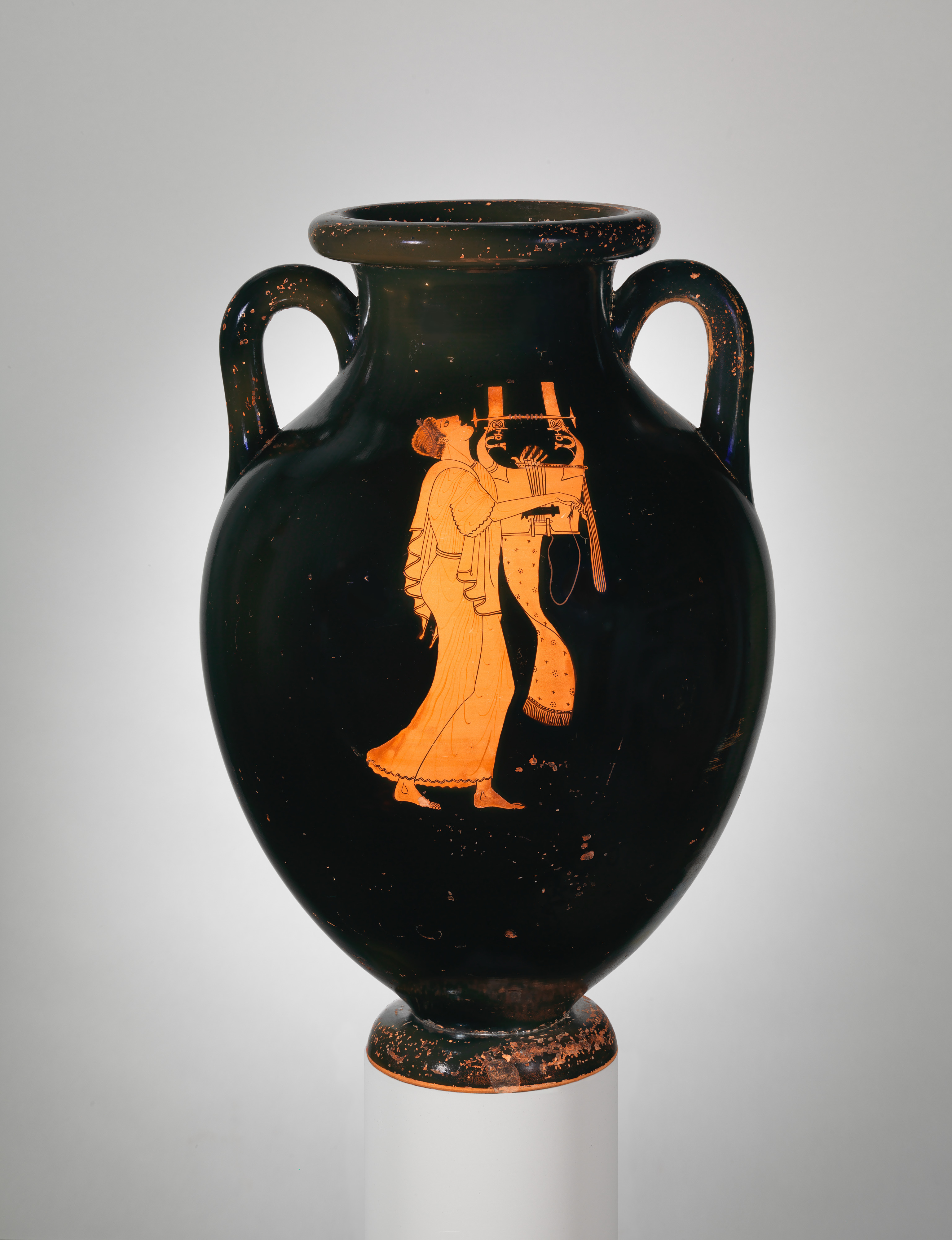
Monday, 23 March 2020

Rhapsode


Terracotta Amphora Attributed to the Berlin Painter
Metropolitan Museum New York
Rhapsody

The tradition of oral epic poetry, from which rhapsodes emerged, predates written records. This tradition, represented by the "aoidoi" (bards), existed well before the 6th century BC.

An ancient Greek rhapsody was a selection of epic poetry sung by a rhapsode or rhapsodist. The word rhapsode comes from the Greek words rhapsōidēs (ῥαψῳδός), which means "stitcher of songs". This is because rhapsodes would often stitch together different passages of epic poetry to create a longer, more cohesive performance. Cleisthenes of Sicyon - Wikipedia abolished all the rhapsodes of Homer because they praised the citizens of Argos. Rhapsodes and Rhetorical Style Rhapsodes played a significant role in the performance and transmission of epic poetry in ancient Greece, with their craft closely intertwined with the development of rhetoric. The earliest incarnation of this function and role were called Aiodoi or Bards or Andres Aoidoi or Singer Men. Rhapsode was the name given to them by Plato. The difference between an Aiodo and a Rhapsode was that
Rhapsodes and Epic Poetry
Rhapsodes were professional performers of epic poetry in ancient Greece. Their name is believed to derive from the Greek word "rhaptein," meaning "to stitch," suggesting that they "stitched together" songs or poetic passages. These performers were primarily known for reciting the works of Homer and other ancient poets, including Hesiod, Archilochus, and Simonides.
Performance Style:
Rhapsodes could perform with musical accompaniment (lyre or aulos) or through declamation alone.
Their performances were often dramatic and spectacular, aimed at moving the audience emotionally.
Rhapsodic recitations became a characteristic part of the Panathenaic festivals in Athens during the 6th and 5th centuries BC.
Evolution from Aoidoi to Rhapsodes
The transition from aoidoi (earlier epic singers) to rhapsodes marks an important shift in the oral tradition of epic poetry:
Aoidoi were associated with pre-literate times and were thought to compose poems anew for each performance. Rhapsodes emerged in a more literate age and often relied on written texts to aid their performances. However, this distinction is not always clear-cut, especially through the 6th century BC.
Rhapsodes and Rhetoric

The connection between rhapsodic performance and rhetoric is multifaceted:
Formalised Systems: Scholars like Richard Enos argue that Aoidoi such as Homer and Hesiod developed formalised systems for presenting and understanding oral literature, contributing to the evolution of rhetoric as a discipline.
Performance Techniques: The dramatic nature of rhapsodic recitations, as described in Plato's "Ion," suggests a strong rhetorical component in their performances.
Commentary and Interpretation: After reciting poems, rhapsodes would often provide commentary, demonstrating analytical and persuasive skills akin to rhetoric.
Influence on Oratory: The performance techniques of rhapsodes likely influenced the development of oratorical skills in ancient Greece.
Historical Perspectives
The relationship between epic poetry, rhapsodic performance, and rhetoric has been subject to various interpretations:
Some ancient thinkers, like Plato, viewed Homeric discourse as predating formal rhetoric and considered it a non-rational approach to expression.
Others, such as Quintilian, recognised the rhetorical value in Homer's composing techniques.
Modern scholars have increasingly acknowledged the rhetorical aspects of epic poetry and its performance, seeing Rhapsodes as important figures in the development of Greek oratory and persuasive speech.

In conclusion, Rhapsodes played a crucial role in bridging the gap between epic poetry and rhetoric, embodying performance techniques that would influence the development of formal oratory in ancient Greece.

Rhapsodes

Rhapsodes were professional performers who travelled from polis to polis, reciting epic poems to audiences. They were often accompanied by music, such as the lyre or aulos. Rhapsodes were highly skilled in the art of improvisation, and they would often add their own commentary and embellishments to the poems they performed.

In preliterate societies, poetry and song served a mnemonic purpose for the memorisation and recital of the legends and folktales of those societies for storytelling which had not been written down. The rhyme and rhythm of a poem or song make the words easier to remember and pass onto others.  In pre-classical Greece, oral poetry was used to relate the tales from Greek myth ─ epic tales of olden-day heroes and their interactions with the gods.

These epic tales were preserved and retold by a professional class of bards or minstrels known as aoidoi or rhapsoidoi (rhapsodes or “song-stitchers”). The craft of the rhapsodes lay in their memory and knowledge of the vast corpus of Greek myth and legend.  They had the ability to select and shape episodes from this corpus for public recitation. This oral poetry was typically sung or recited in the flowing rhythm of dactylic hexameter. In general Greek poetry did not use rhyme; the Ancient Greek language had too many natural rhythms for this to be considered beautiful.

At religious festivals throughout the Athenian year. Rhapsodes, the professional performers and singers of Homeric and other epics, sought an audience at the religious events where the crowds were so gathered. As with many Greek institutions competition was important. Rhapsodes formally competed against one another before groups of judges. The winner was awarded a prize. Such competitions may have been the origins of the competitions held at the Dionysian and Lenaean festivals for tragedy and comedy theatrical performances.

It was the rhapsodes who educated the Greek masses in their mythology,

Here are some of the more famous ancient Greek rhapsodes:

Demodocus of Rhodes, who was mentioned in Homer's Odyssey as a Rhapsode who performed at the court of Alcinous, king of the Phaeacians on Corfu.

Epicharmus of Cos was a rhapsode and poet who lived in the 6th century BC.

Stesichorus of Himera was a rhapsode and poet who lived in the 7th and 6th centuries BC.

Arion of Lesbos, was a rhapsode and poet who lived in the 7th and 6th centuries BC.

Homer, the legendary author of the Iliad and the Odyssey.

It is possible to consider Thespis to have started by being an Aiodo for he travelled from place to place, performing before audiences, but the traditional story is that he was originally a choir boy who sang dithyrambs, which were songs about stories from mythology, for the public. Later he became known as the first actor and the inventor of tragedy in Ancient Greek theatre performance by stepping out of the Chorus line of the dithyrambic performance.

Rhapsodes and Ancient Greek Drama

It is very likely that Rhapsodes had a significant influence on the origin of Ancient Greek drama. Rhapsodes were professional performers of epic poetry, most famously the works of Homer like the Iliad and Odyssey. Their role in the oral tradition and public performance provided a foundation for the development of Greek theatrical practices in several ways:

Performance Techniques
: Rhapsodes were skilled in recitation, often using expressive voice, gestures, and rhythm to engage audiences. These techniques likely influenced the dramatic styles employed in early Greek drama, particularly the use of actors and the chorus.

Storytelling and Myth
: The content of rhapsodic performances, which centred on myths and heroic tales, formed the narrative core of much of Greek drama. Tragedies and comedies frequently drew from the same mythological corpus, reinterpreting the stories for theatrical presentations.

Choral Elements: The rhapsodic tradition also emphasised the communal and ritualistic aspects of performance. The chorus in Greek drama, which played a central role in early tragedies, might have evolved from similar collective narrative practices found in epic recitations.

Religious and Civic Context: Rhapsodic performances were often part of religious festivals, such as the Panathenaic Festival in Athens, which celebrated Athena. Similarly, Greek drama emerged in a religious context, particularly during festivals honoring Dionysus, like the City Dionysia. The overlap in ritualistic function suggests a continuity in the cultural use of performance.

Transition to Dialogue: While rhapsodes performed solo with an emphasis on narrative, Greek drama introduced dialogue between characters, often derived from interactions hinted at in epic poetry. This evolution from monologue to dialogue was a pivotal step towards fully developed drama.

Use of Odeons: In ancient Greece odeons were small, roofed theatres used for musical performances, poetry recitals, and political gatherings. Rhapsodes used odeons for their performances. Unlike the larger open-air theatres they were designed for indoor use. The most famous example of an odeon is the Odeon of Herodes Atticus in Athens, built in 161 AD on the south side of the Acropolis. Their design was influenced by the theatrons of large, open-air Greek theatres but adapted for indoor use. They were roofed to enhance acoustics; this was also a necessity in Bouleuterions. They had tiered seating similar to the theatres used for drama but in a smaller, more intimate layout.

References


Pindar - Wikipedia

Search results for Aoidoi in JSTOR

The Oxford Classical Dictionary : Ross, W. D. Ed.- Rhapsodes - Internet Archive

Ion (dialogue) - Wikipedia

The Internet Classics Archive - Ion by Plato

The Cambridge Companion to Greek Lyric - Google Books

Greek Rhetoric before Aristotle : Enos, Richard Leo - Internet Archive

The Concise Oxford Companion to Classical Literature: Howatson, M. C - Internet Archive

The Ancient Greek Hero in 24 Hours : Nagy, Gregory - Internet Archive

A Companion to Ancient Epic - Google Books
A Companion to Ancient Epic - Internet Archive


Jonathan Ready; Christos Tsagalis (13 August 2018). Homer in Performance: Rhapsodes, Narrators, and Characters. University of Texas Press. ISBN 978-1-4773-1603-0.

George Grote (1882). A History of Greece from the Earliest Period to the Close of the Generation Contemporary with Alexander the Great. Allison. pp. 135–.

Judith A. Hamera (2006). Opening Acts: Performance In/as Communication and Cultural Studies. SAGE. ISBN 978-1-4129-0558-9.

Tragedy and Epic by Ruth Scodel in a Companion to Tragedy - Wiley Online Library

Jonathan Ready; Christos Tsagalis (13 August 2018). Homer in Performance: Rhapsodes, Narrators, and Characters. University of Texas Press. ISBN 978-1-4773-1603-0.

Dictionary of the Ancient Greek World

Rhapsodes at Festivals
Martin L. West
Zeitschrift für Papyrologie und Epigraphik
Bd. 173 (2010), pp. 1-13
Published by: Dr. Rudolf Habelt GmbH
https://www.jstor.org/stable/20756824

González, José M. 2013. The Epic Rhapsode and His Craft: Homeric Performance in a Diachronic Perspective. Hellenic Studies Series 47. Washington, DC: Center for Hellenic Studies.
http://nrs.harvard.edu/urn-3:hul.ebook:CHS_GonzalezJ.The_Epic_Rhapsode_and_his_Craft.2013.
   10. The Rhapsode in Performance
   13. Rhapsodic hypokrisis and Aristotelian lexis

Introduction: Toward an Understanding of Greek Poetic Contestation - Center for Hellenic Studies


Friday, 21 February 2020

Dramatic Irony

Dramatic irony is that situation where the audience watching a play are fully aware what is happening on stage and in the story at any given moment, whereas and whilst the characters themselves appear to be totally unaware of what is happening to them.

There is another feature about dramatic irony. Many of the plots of Ancient Greek plays were based on well-known myths and legends, many of which would have been well-known to the contemporary audiences then. They, the public, all knew what was going to happen next. The use of a well-known myth or story meant that the audience was always in anticipation of the downfall of the principal character in the case of a tragedy as the play progressed. Dramatic Irony could work both ways.  Of course the playwright could change the plot of the myth or legend if he so wanted thereby creating a surprise for his audience who were expecting some other outcome, or they could have their ironic expectation satisfied.

Irony as a Dramatic Tool

Irony, particularly dramatic irony, is a cornerstone of Sophocles' Oedipus Rex. The audience is privy to information that the characters are not, creating a sense of foreboding and tension. This discrepancy between knowledge creates a powerful dramatic effect.

Dramatic Irony: The audience knows Oedipus is the murderer they seek, while he remains oblivious. This knowledge intensifies the dramatic impact of his investigation.

Situational Irony: Oedipus flees Corinth to avoid fulfilling a prophecy, only to inadvertently to fulfil it. This ironic twist highlights the futility of his attempts to control fate.

Verbal Irony: Oedipus mocks Tiresias for his blindness, ironically highlighting his own spiritual blindness.

References

Philip Vellacott (12 June 1975). Ironic Drama: A Study of Euripides' Method and Meaning. CUP Archive. ISBN 978-0-521-09896-0.

Helene P. Foley (15 March 2019). Ritual Irony: Poetry and Sacrifice in Euripides. Cornell University Press. ISBN 978-1-5017-4063-3.
Ritual Irony - Poetry and Sacrifice in Euripides - Internet Archive

Robert L. Perkins (2001). The Concept of Irony. Martin Antic: Clouds of Irony: Mercer University Press. pp. 161–. ISBN 978-0-86554-742-1.

On the pretense theory of irony. [PDF]


Some Aspects of Dramatic Irony in Sophoclean Tragedy
S. K. Johnson
The Classical Review
Vol. 42, No. 6 (Dec., 1928), pp. 209-214
Published by: Cambridge University Press on behalf of The Classical Association
https://www.jstor.org/stable/701419

Philological Museum vol 2/On the Irony of Sophocles - Wikisource

Ritual Irony - Poetry and Sacrifice in Euripides - Internet Archive
Ritual Irony: Poetry and Sacrifice in Euripides - Helene P. Foley - Google Books

Parody

For the ancient Greeks, parody was a comic imitation of a serious poem. "Parody," in Greek and Roman times, referred to (1) "a poem of burlesque or parody in the Homeric style, mock epic", (2) various kinds of imitation, quotation, adaptation, and paraphrase usually comic but not necessarily so; and (3) punning and wordplay. Parody renders its subject's form, style and language ludicrous. A parody is a composition that imitates the style of another composition, normally for comic effect and often by applying that style to an outlandish or inappropriate subject.


References

Graham Ley (1 February 2012). A Short Introduction to the Ancient Greek Theater: Revised Edition. Parody: University of Chicago Press. pp. 74–. ISBN 978-0-226-15467-1.

Robert Chambers (2010). Parody: The Art that Plays with Art. Peter Lang. ISBN 978-1-4331-0869-3.

Margaret A. Rose (9 September 1993). Parody: Ancient, Modern and Post-modern. Cambridge University Press. ISBN 978-0-521-42924-5.

Donald Sells (13 December 2018). Parody, Politics and the Populace in Greek Old Comedy. Bloomsbury Publishing. ISBN 978-1-350-06053-1.

James Robson; James E. Robson (2006). Humour, Obscenity and Aristophanes. Tragic Parody: Gunter Narr Verlag. pp. 51–. ISBN 978-3-8233-6220-3.

Aristotle - Poetics 1448a

Aristotle; Richard Janko (1987). Aristotle: Poetics. Hackett Publishing. pp. 164–. ISBN 0-87220-033-7.

ΠAPΩIΔIA
Fred W. Householder, Jr.
Classical Philology
Vol. 39, No. 1 (Jan., 1944), pp. 1-9
Published by: The University of Chicago Press
https://www.jstor.org/stable/263900

Identification of Parodies in Aristophanes
Alfred Cary Schlesinger
The American Journal of Philology
Vol. 58, No. 3 (1937), pp. 294-305
Published by: The Johns Hopkins University Press
DOI: 10.2307/290328
https://www.jstor.org/stable/290328

The Basis of Ancient Parody
F. J. Lelièvre
Greece & Rome
Vol. 1, No. 2 (Jun., 1954), pp. 66-81
Published by: Cambridge University Press on behalf of The Classical Association
https://www.jstor.org/stable/641056

Indications of Parody in Aristophanes
Alfred Cary Schlesinger
Transactions and Proceedings of the American Philological Association
Vol. 67 (1936), pp. 296-314
Published by: The Johns Hopkins University Press
DOI: 10.2307/283243
https://www.jstor.org/stable/283243

Demosthenes, Parody and the "Frogs"
Filippomaria Pontani
Mnemosyne
Fourth Series, Vol. 62, Fasc. 3 (2009), pp. 401-416
Published by: Brill
https://www.jstor.org/stable/27736351

Sick Humour: Aristophanic Parody of a Euripidean Motif?
F. D. Harvey
Mnemosyne
Fourth Series, Vol. 24, Fasc. 4 (1971), pp. 362-365
Published by: Brill
https://www.jstor.org/stable/4430022

Aristophanes and Sophron?
Lloyd W. Daly
The American Journal of Philology
Vol. 103, No. 1 (Spring, 1982), pp. 86-88
Published by: The Johns Hopkins University Press
DOI: 10.2307/293965
https://www.jstor.org/stable/293965

Euripides' parody of Aeschylus
Godfrey W. Bond
Hermathena
No. 118, SPECIAL NUMBER IN HONOUR OF HERBERT WILLIAM PARKE: Magistro Dilectissimo Discipuli (Winter 1974), pp. 1-14
Published by: Trinity College Dublin
https://www.jstor.org/stable/23040568

"Deinon Eribremetas": The Sound and Sense of Aeschylus in Aristophanes' "Frogs"
Elizabeth W. Scharffenberger
The Classical World
Vol. 100, No. 3 (Spring, 2007), pp. 229-249
Published by: The Johns Hopkins University Press on behalf of the Classical Association of the Atlantic States
https://www.jstor.org/stable/25434023

https://en.wiktionary.org/wiki/sophron
https://en.wiktionary.org/wiki/parody

Thursday, 23 January 2020

Trial and Execution of Socrates - 399 BC

This event at this time concerns one of the most shameful acts that which occurred in Athens, one which could be said to mark the end of its Golden Age: the trial and execution of Socrates in 399 BC Socrates, Athens most famous philosopher, beloved of Plato, was always asking for trouble. Indeed his very method of philosophical inquiry upset some of the most important people and politicians of Ancient Athens. Someone, a friend of Socrates. once asked the Oracle at Delphi who was the wisest man in all Athens. The Pythia, priestess of the Oracle, answered that it was Socrates. This friend told Socrates what the Oracle had said to him. Socrates set out to try to prove the Oracle wrong. He would try and find out if anyone knew what was truly worthwhile in life, because if anyone knew the answer to that question they must surely be wiser than him. He went around all of Athens. He questioned everyone of note he encountered, but none of them gave him a satisfactory answer. Instead they all pretended to know something when it was clear they did not.  Socrates was the wisest. Why? Because he claimed he knew nothing at all. He knew and admitted that he knew nothing and by his method of logic he could prove it.   Everyone he encountered and questioned always all of them claimed they had knowledge. Socrates made fools of them all. Perhaps it was for this insolence he ended up being tried and executed.

Athens at this time, had just recently suffered defeat in the Peloponnesean war against Sparta and her allies. Socrates was a known Laconophile, an admirer of Sparta, possibly not a popular type to claim to be at this time. Perhaps he liked the certainty that the constitution that Sparta provided her citizens with. Sparta had reintroduced and imposed on Athens a hugely unpopular aristocratic and tyrannical government upon Athens, known as the Thirty Tyrants, one which was more favourable to Sparta. Socrates was a known anti-democrat. He is known to have had personal connections with a number of the tyrants. Socrates praised the Spartans because even though they were simple men and women, they were men and women who, as far as their character was concerned, were better than the Athenians. Socrates did not necessarily praise the Spartan form of government so much as he did the Spartan moral character. Socrates was very critical of some of Athens' leading politicians, especially those who carried out policies that pandered to its masses. He definitely did not like its form of government.

Socrates considered himself as having the mission in life to make people think for themselves. He tried to provide them with the skills for this.  He is often called the Father of Scepticism. He personally despised demagoguery. He wanted people to see through the falsities of  the rhetoric as exploited by the demagogues, how they used its methods for their own selfish purposes.

In 399 BC all this culminated in Socrates trial and execution. Charges were brought against him with the following wording:-

"Socrates does not believe in the gods in whom our city believes, but introduces other new deities; he is corrupting the young. The penalty demanded - Death".

He was over 70 when he was accused of this.

During his trial he is reported to have said the following:

“The unexamined life is not worth living.”
“I believe in the gods, like none of my accusers do.”

Plato shows him casting doubt on the notion that morality has a divine origin. Socrates never says that there are no gods; only that his fellow citizens misunderstand them (and everything else).

"The profession of one's own ignorance is a necessary first step on the way to the truth."

He was tried in the Council of 500 : 280 found him guilty, 220 found him innocent

Some have argued that Socrates had been a friend of those in power during the period of the Thirty Tyrants, and also of Alcibiades, the traitor. Many of Athens citizens suspected him of conspiring with the Tyrants.

The description of the trial of Socrates and his subsequent execution by being forced to drink the poison hemlock are described in the following of Plato's books:-

Euthyphro
Apology
Crito
Phaedo

References

A Companion to Greek and Roman Political Thought: Chapter 21 The Trial and Death of Socrates - Google Books

Criminal Procedure in Ancient Greece and the Trial of Socrates

http://en.wikisource.org/wiki/Euthyphro
http://en.wikisource.org/wiki/Crito
https://en.wikisource.org/wiki/Phaedo
http://en.wikisource.org/wiki/Apology_(Plato)

Plato, The Apology of Socrates -SB

Ancient Greek Skepticism

https://plato.stanford.edu/entries/social-ontology/history.html#AnciPhilNatuVersAgre

Ancient Political Philosophy - Socrates and Plato

Sophist - Wikipedia

The Thirty Tyrants - Wikipedia

The Trials of Socrates

Socrates - Stanford Encyclopaedia of Philosophy

Laconophilia - Wikipedia
Irony - Wikipedia
Socratic method - Wikipedia
The unexamined life is not worth living - Wikipedia
The Clouds - WikipediaTrial of Socrates - Wikipedia
Socrates - Wikipedia
Socratic problem - Wikipedia
http://plato.stanford.edu/entries/skepticism-ancient/
http://en.wikipedia.org/wiki/Academic_skepticism

The trial and death of Socrates : Plato - Internet Archive

The Cambridge Companion to Socrates - Internet Archive

Socrates was charged with asebeia punished for lack of reverence due to the gods.  
https://bit.ly/2LgBmJo

James A. Colaiaco (2013). Socrates Against Athens: Philosophy on Trial. Routledge. ISBN 978-1-135-02493-2.

Xenophon (2001). Memorabilia. Cornell University Press. ISBN 0-8014-8171-6.

Aristophanes; Peter Meineck (tr) (2000). Clouds. Hackett Publishing. ISBN 0-87220-516-9.

Alexander Rubel; Michael Vickers (11 September 2014). Fear and Loathing in Ancient Athens: Religion and Politics During the Peloponnesian War. Routledge. ISBN 978-1-317-54480-7.

R. E. Allen (1981). Socrates and Legal Obligation. U of Minnesota Press. ISBN 978-0-8166-5692-9.

Ernst Curtius (1874). The History of Greece. Volume 4. Prosecution and Execution of Socrates: C. Scribner. pp. 158–.

Bettany Hughes (2011). The Hemlock Cup: Socrates, Athens and the Search for the Good Life. Random House. ISBN 978-1-4464-1916-8.

The Oxford Classical Dictionary - Greek Rhetoric : Ross, W. D. Ed. - Internet Archive

Ian Worthington (11 December 2006). A Companion to Greek Rhetoric. Wiley. ISBN 978-1-4051-2551-2.

Ancient Greece - Principles of Public Speaking

Adam Parry (20 July 1972). Studies in Fifth Century Thought and Literature. Cambridge University Press. ISBN 978-0-521-08305-8.

Xanthakis-Karamanos, Georgia. “The Influence of Rhetoric on Fourth-Century Tragedy.” The Classical Quarterly, vol. 29, no. 1, 1979, pp. 66–76. JSTOR, www.jstor.org/stable/638606

Michael John MacDonald (2017). The Oxford Handbook of Rhetorical Studies. Chapter 7 - Paul Woodruff - Rhetoric and Tragedy: Oxford University Press. pp. 97–. ISBN 978-0-19-973159-6.

Joseph Roisman; Ian Worthington (2015). Lives of the Attic Orators: Texts from Pseudo-Plutarch, Photius, and the Suda. Oxford University Press. ISBN 978-0-19-968767-1.

Plato; Aristophanes (1998). Four Texts on Socrates: Plato's Euthyphro, Apology, and Crito, and Aristophanes' Clouds. Aristophanes Clouds: Cornell University Press. pp. 115–. ISBN 0-8014-8574-6.

Greek Drama and the Invention of Rhetoric - David Sansone - Google Books

The Oxford Handbook of Rhetorical Studies - Google Books

Rhetorical Action in Ancient Athens: Persuasive Artistry from Solon to ... - James Fredal - Google Books

Monday, 13 January 2020

The Graeco-Persian Wars


Ionian Revolt 499 BC to 493 BC

499 BC
After a failed attack on the rebellious island of Naxos in the name of the Persians, Aristagoras, in order to save himself from the wrath of Persia, plans a revolt with the Milesians and the other Ionians. With the encouragement of Histiaeus (his father-in-law and former tyrant of Miletus. he induces the Ionian cities of Asia Minor to rise up against Persia, thus instigating the Ionian Revolt and the beginning of the Graeco-Persian Wars. The pro-Persian tyrant of Mytilene is stoned to death.

Miltiades the Younger, the ruler of the Thracian Chersonese, which has been under Persian suzerainty since about 514 BC, joins the Ionian revolt. He seizes the islands of Lemnos and Imbros from the Persians. Aristagoras seeks help with the revolt from Cleomenes I, king of Sparta, but the Spartans are unwilling to respond.

498 BCAthens and Eretria respond to the Ionian plea for help against Persia and send troops. A joint Athenian and Eretrian fleet transports Athenian troops to Ephesus, where they are joined by a force of Ionians. They march on Sardis, the capital of Lydia where Artaphernes is satrap. He is brother of Darius I). Artaphernes, who has sent most of his troops to besiege Miletus, is taken by surprise. However, he is able to retreat to the citadel and hold it. Even though the Greeks are unable to capture the citadel, they pillage the town and set fire to Sardis burning it to the ground. Retreating to the coast, the Greek forces are met by Artaphernes’ forces, and defeated in the Battle of Ephesus.

The revolt widens. Kaunos and Caria, followed by Byzantium and other towns in the Hellespont also rebel against the Persians. Cyprus also joins in, as Onesilus removes his pro-Persian brother, Gorgos, from the throne of Salamis.

497 BCThe Persians launch an expedition on the Hellespont and later Caria .

496 BCHipparchos, [son of Charmos and a relative of Peisistratos] is made Eponymous Archon of Athens. He leads the cause of peace arguing that resistance to the Persians is useless. He is friends with the tyrants of Athens. [He is later ostracized, in 488/7 BC].

494 BCThe Phoenician allies of the Persia exact savage reprisals on the Greeks, whom they regard as pirates.

The Thracians and Scythians drive Miltiades the Younger from the Chersonesos. Miltiades loads five boats with his treasures and makes for Athens. One of the boats, captained by Miltiades' eldest son, Metiochos is captured becoming a lifelong prisoner to Persia.

The Spartan king, Cleomenes I inflicts a severe defeat on Argos at Sepeia near Tiryns.

The former tyrant of Miletus, Histiaeus is captured by the Persians and executed at Sardis by Artaphernes.

493 BCThe people of Athens elect Themistocles as Eponymous Archon, the chief judicial and civilian executive officer in Athens. He favours resistance against the Persians. Themistocles begins the construction of a fortified naval base for Athens at the port of Piraeus.

Among the refugees escaping from Ionia after the collapse of the Ionian Revolt is a chief named Miltiades. He has a fine reputation as a soldier and favourably presents himself as a defender of Greek freedoms against Persian despotism. Themistocles appoints him as a general in the Athenian army.

http://en.wikipedia.org/wiki/Siege_of_Naxos_(499_BC)Ionian Revolt- Military Wikia - FandomBattle of Ephesus


First Persian invasion of Greece (492–490 BC)


492 BC
The first Persian expedition by Darius the Great against mainland Greece takes place under the leadership of his son-in-law and general, Mardonius. Darius the Great, was the fourth Persian King of Kings of the Persian Achaemenid Empire. Darius sends Mardonius to succeed his satrap Artaphernes in Ionia, with a special commission to launch an attack on Athens and Eretria.

The Persians under Mardonius subdue and capture Thrace and Macedonia. But he loses some 300 ships in a storm off Mount Athos, which forces him to abandon his plans to attack Athens and Eretria.

491 BCDarius I sends envoys to all Greek cities, demanding "earth and water”, as symbols of their submission to his overlordship and their surrender. Athens and Sparta refuse to capitulate..

The Greek island city-state of Aegina, fearing loss of trade, submits to Persia. The Spartan king, Cleomenes I tries to punish Aegina for having done this, but the other Spartan king, Demaratus, thwarts him. Cleomenes I engineers the deposition of Demaratus replacing him with his cousin Leotychidas. He does this by bribing the oracle at Delphi to announce that this action was divine will. The two Spartan kings now successfully capture the Persian collaborators in Aegina.

490 BCDarius I sends an expedition, under Artaphernes and Datis the Mede across the Aegean to attack the Athenians and the Eretrians. Hippias, the aged ex-tyrant of Athens, is on board of one of the Persian ships in the hope of being restored to power in Athens.

When the Ionian Greeks in Asia Minor revolted against Persia in 499 BC, Eretria joined with Athens in sending aid to the rebels. Darius wants to teach them both a severe lesson. The Persians capture Eretria. It is sacked and burned and its inhabitants enslaved. Darius intends the same fate for Athens.

September 12 – The Battle of Marathon takes place as a Persian army of more than 20,000 men attempt an invasion. Hippias advise them to land in the Bay of Marathon, where they meet the Athenians supported by the Plataeans. The Persians are repulsed by 11,000 Greeks under the leadership of Callimachus and Miltiades. Some 6,400 Persians are killed at a cost of 192 Athenian dead. Callimachus, the war-archon of Athens, is killed during the battle. After the battle the Persians return home.

Before the battle, the Athenians send a runner, Pheidippides, to seek help from Sparta. But the Spartans delay sending troops because of their religious requirements (the Carnea) mean they must wait for the full moon.

The Greek historian Herodotus, the main source for the Greco-Persian Wars, names the famous messenger [Pheidippides] who runs from Athens to Sparta asking for help, and then runs back, a distance of over 240 kilometres each way. After the battle, he runs back to Athens to spread the news and raise its morale. It is claimed that his last words before collapsing and dying in Athens are "Chairete, nikomen" ("Rejoice, we are victorious").

Hippias dies at Lemnos on the way back to Sardis after the Persian defeat.

Cleomenes I is forced to flee Sparta when his plot against Demaratus is uncovered, but the Spartans allow him to return when he begins gathering an army in the surrounding territories. However, by this time he has become insane, and the Spartans put him in prison. Shortly after this, he commits suicide. He is succeeded by his half-brother, Leonidas.

Battle of Marathon - Military Wiki - Fandom

Second Persian invasion of Greece (480–479 BC)

The Second Persian invasion of Greece (480–479 BC) that occurred during the Graeco-Persian Wars, was only after a 10 year delay, when King Xerxes I sought to subjugate all of Greece. The invasion was a direct answer to the defeat of the First Persian invasion of Greece (492–490 BC) with Persia had suffered at the Battle of Marathon.

480 BCMay – King Xerxes I of Persia marches from Sardis and onto Thrace and Macedonia.

The Greek congress decides to send a force of 10,000 Greeks, including hoplites and cavalry, to the Vale of Tempe, through which they believe the Persian army will pass. The force includes Lacedaemonians led by Euanetos and Athenians under Themistocles. Warned by Alexander I of Macedon that the vale can be bypassed elsewhere and that the army of Xerxes is overwhelming, the Greeks decide not to try to hold there and vacate the vale.

August 20 or September 8-10 – The Battle of Thermopylae ends in victory for the Persians under Xerxes. His army engulfs a force of 300 Spartans and 700 Thespiae under the Spartan King, Leonidas I. The Greeks under Leonidas resist the advance through Thermopylae of Xerxes' vast army. For two days Leonidas and his troops withstand the Persian attacks; he then orders most of his troops to retreat, and he and his 300-member royal guard fight to the last man.
Pausanias becomes regent for King Leonidas' son, Pleistarchus, after Leonidas I is killed at Thermopylae. Pausanias is a member of the Agiad royal family, the son of King Cleombrotus and nephew of Leonidas.


Phocis and the coasts of Euboea are devastated by the Persians. Thebes and most of Boeotia join Xerxes.


King Alexander I of Macedon is obliged to accompany Xerxes in a campaign through https://en.wikipedia.org/wiki/Pausanias, though he secretly aids the Greek allies. With Xerxes' apparent acquiescence, Alexander seizes the Greek colony of Pydna and advances his frontiers eastward to the Strymon, taking in Crestonia and Bisaltia, along with the rich silver deposits of Mount Dysorus.

The Athenian soldier and statesman, Aristides, as well as the former Athenian archon Xanthippus, return from banishment in Aegina to serve under Themistocles against the Persians.

August – The Persians achieve a naval victory over the Greeks in an engagement fought near Artemisium, a promontory on the north coast of Euboea. The Greek fleet holds its own against the Persians in three days of fighting but withdraws southward when news comes of the defeat at Thermopylae.

Breaking through the pass at Thermopylae from Macedonia into Greece, the Persians occupy Attica.

September 21 – The Persians sack Athens, whose citizens flee to Salamis and then Peloponnesus.

September 22 – The Battle of Salamis brings victory to the Greeks, whose Athenian general Themistocles lures the Persians into the Bay of Salamis, between the Athenian port-city of Piraeus and the island of Salamis. The Greek triremes then attack furiously, ramming or sinking many Persian vessels and boarding others. The Greeks sink about 200 Persian vessels while losing only about 40 of their own. The rest of the Persian fleet is scattered, and as a result Xerxes has to postpone his planned land offensives for a year, a delay that gives the Greek city-states time to unite against him.
Aeschylus is fighting on the winning side.

An eclipse of the sun discourages the Greek army from following up the victory of Salamis. Xerxes returns to Persia leaving behind an army under Mardonius, which winters in Thessaly.

Battle_of_Thermopylae

Thermopylae : the battle that changed the world : Cartledge, Paul - Internet Archive

Battle_of_Artemisium

Battle_of_Salamis

The battle of Salamis : Barry S. Strauss - Internet Archive


479 BCMardonius, from his base in Thessaly, wins support from Argus and western Arcadia. He tries to win over Athens but fails. He attacks Athens once again. This time the Athenians are forced to flee their city. The Persians raze Athens to the ground. The Spartans march north in support of Athens.

August 27 - The Battle of Plataea in Boeotia ends the Persian invasions of Greece as Mardonius and his forces are routed by the Greeks under Pausanias, nephew of the former Spartan King, Leonidas I. The Athenian contingent is led by the repatriated Aristides. Mardonius is killed in the battle and the Greeks capture enormous amounts of loot. Thebes is captured shortly thereafter and the Theban collaborators are executed by Pausanias.

Meanwhile at sea, the Persians are defeated by a Greek fleet headed by Leotychidas of Sparta and Xanthippus of Athens in the Battle of Mycale, off the coast of Lydia in Asia Minor.

Potidaea is struck by a tsunami during a siege saving it from a Persian attack.

[During the siege, the tide seemed to retreat much farther than usual, creating a convenient invasion route. But this wasn't a stroke of luck. Before the Persians had crossed halfway, the water returned in a wave much higher than anyone had ever seen before, drowning the attackers. The Potidaeans believed they were saved by the wrath of Poseidon. But what really had saved them was a tsunami.]

Battle of Plataea - Wikipedia

Battle of Mycale - Wikipedia


The Delian League
The Delian League was founded in 478 BC. It was an alliance of Greek city-states, including many of the islands in the Aegean and most of the city-states of Ionia, in all well over 150 members and possibly considerably more, all under the leadership of Athens. Its purpose was to continue to pursue the fight against the Persian Empire after the victory in the Battle of Plataea at the end of the Second Persian Invasion of Greece.

Its official meeting place was the island of Delos, where congresses were held in the temple and where the treasury stood until Pericles moved it to Athens in 454 BC.

Delian League - Military Wikia - Fandom
Themistocles
472_BC or 471 BC,Themistocles is ostracised


466 BCCimon carries the war against Persia into Asia Minor and wins the Battle of the Eurymedon in Pamphylia. This is a decisive defeat of the Persians by Cimon's and his land and sea forces who manage to capture the Persian camp and destroy or capture the entire Persian fleet of 200 triremes (manned by the Phoenicians). Many new allies of Athens are now recruited, such as the trading city of Phaselis on the Lycian-Pamphylian border.

http://military.wikia.org/wiki/Battle_of_the_Eurymedon


465/4 BCKing Xerxes I of the Persian Empire and his eldest son, are assassinated by one of his Ministers, Artabanus the Hyrcanian who served either as his vizier or as head of his bodyguard. The Persian general, Megabyzus, is thought to have been one of the conspirators in the assassination. Artabanus takes control of the empire as regent for several months. However, he is betrayed by Megabyzus , and is killed before he could kill the new emperor, Artaxerxes Xerxes' son. Megabyzus is appointed satrap of Syria.

Egypt seizes the opportunity created by the murder of Xerxes to revolt against Persia. The revolt is led by Inaros, a Libyan, who gains control of the Delta region and is aided by the Athenians.

463 BC
Cimon is charged by Pericles and other democratic politicians with having been bribed not to attack Macedonia which has been suspected of covertly helping the Thasian rebels) Although Kimon is acquitted, his influence on the Athenian people is waning.

Themistocles, who is in exile, approaches the Persian King Artaxerxes I seeking Persian help in regaining power in Athens. Artaxerxes is unwilling to help him, but instead gives him the satrapy of Magnesia.

460_BCEgypt revolts against Persian rule. The Egyptian leader, Inaros, asks Athens for assistance, which is willingly provided as Athens has plans to trade with and colonise Egypt. A force of 200 Athenian triremes, which is campaigning in Cyprus, is immediately ordered to set sail for Egypt to render assistance.
Achaemenes, Persian satrap of Egypt, is defeated and is slain during a battle at Papremis, on the banks of the Nile by Egyptian forces.

The First Peloponnesian War breaks out between the Delian League (led by Athens) and a Peloponnesian alliance (led by Sparta), caused in part by Athens' alliance with Megara and Argos and the subsequent reaction of Sparta. The Athenians have built long walls for the Megarans to their port at Nisaea, thereby earning the enmity of Megara's old rival Corinth, Sparta’s ally.

Argos rises against Sparta. Athens supports Argos and Thessaly. The small force that has been sent by Sparta to quell the uprising in Argos is defeated by a joint Athenian and Argos force at the Battle of Oenoe.


Why didn't the Greeks unite into a single nation after winning the Persian Wars?
An important question to ask is why was that the Greeks didn't unite into a single nation after winning the Persian Wars?

After winning the Persian Wars in the early 5th century BCE, the Greek city-states did not unite into a single nation for several reasons rooted in their historical, cultural, and political context:

a) Political Independence and Autonomy: The Greek city-states, or poleis, highly valued their independence and autonomy. Each polis had its own government, laws, customs, and identity. This strong sense of local identity made them resistant to the idea of unifying under a single political structure.

b) Geographical Factors: Greece's mountainous terrain and scattered islands contributed to the development of isolated, self-sufficient city-states. This geographical fragmentation made communication and centralised control challenging, reinforcing the independence of each polis.

c) Different Political Systems: The Greek city-states had diverse forms of government, ranging from democracy in Athens to oligarchy in Sparta. These differing political systems created conflicting ideologies and governance methods, making it difficult to agree on a unified political structure.

d) Rivalries and Conflicts: There were long-standing rivalries and conflicts among the city-states, most notably between Athens and Sparta. The Peloponnesian War (431-404 BCE), a protracted and destructive conflict between these two major powers and their allies, highlighted the deep divisions and mutual distrust among the Greek states.

e) The Greek City States preferred Alliances to Unification: rather than unifying into a single nation, the Greek city-states preferred to form alliances to address common threats. The Delian League, led by Athens, and the Peloponnesian League, led by Sparta, are examples of just such alliances. These leagues were more about mutual defence and hegemony rather than genuine political unification.

f) Cultural Differences: Despite a shared language and religious beliefs, the Greek city-states had significant cultural differences. Each polis had its own patron gods, festivals, and traditions, which contributed to a strong sense of local identity.

g) Leadership and Hegemony: Attempts at leadership and hegemony by powerful city-states, such as Athens during the height of the Delian League, often led to resistance and conflict rather than unification. Other city-states were wary of domination by a single polis and preferred to maintain their independence.

In summary, the Greek city-states did not unite into a single nation after the Persian Wars due to their strong emphasis on local independence, geographical challenges, diverse political systems, inter-state rivalries, and cultural differences. These factors combined to maintain the fragmented political landscape of ancient Greece.


Hippeis - Wikipedia
Mardonius - Wikipedia
Battle of Plataea - Military Wiki - Fandom
Mardonius - Military Wiki - Fandom

Greece and Rome at War: Connolly, Peter - Internet Archive


Lionel Casson (2014). Ships and Seamanship in the Ancient World. Princeton University Press. ISBN 978-1-4008-5346-5.


William Shepherd (2019). The Persian War in Herodotus and Other Ancient Voices. Bloomsbury Publishing. ISBN 978-1-4728-0865-3.

Tom Holland (21 April 2011). Persian Fire: The First World Empire, Battle for the West. Little, Brown Book Group. ISBN 978-0-7481-3103-7.

The wars of the ancient Greeks : and their invention of western military culture : Hanson, Victor Davis - Internet Archive.