Sunday, 29 December 2024

Aristotle's Three Modes of Persuasion: Ethos, Pathos & Logos

 Aristotle described three rhetorical modes of persuasion: Ethos, Pathos & Logos.
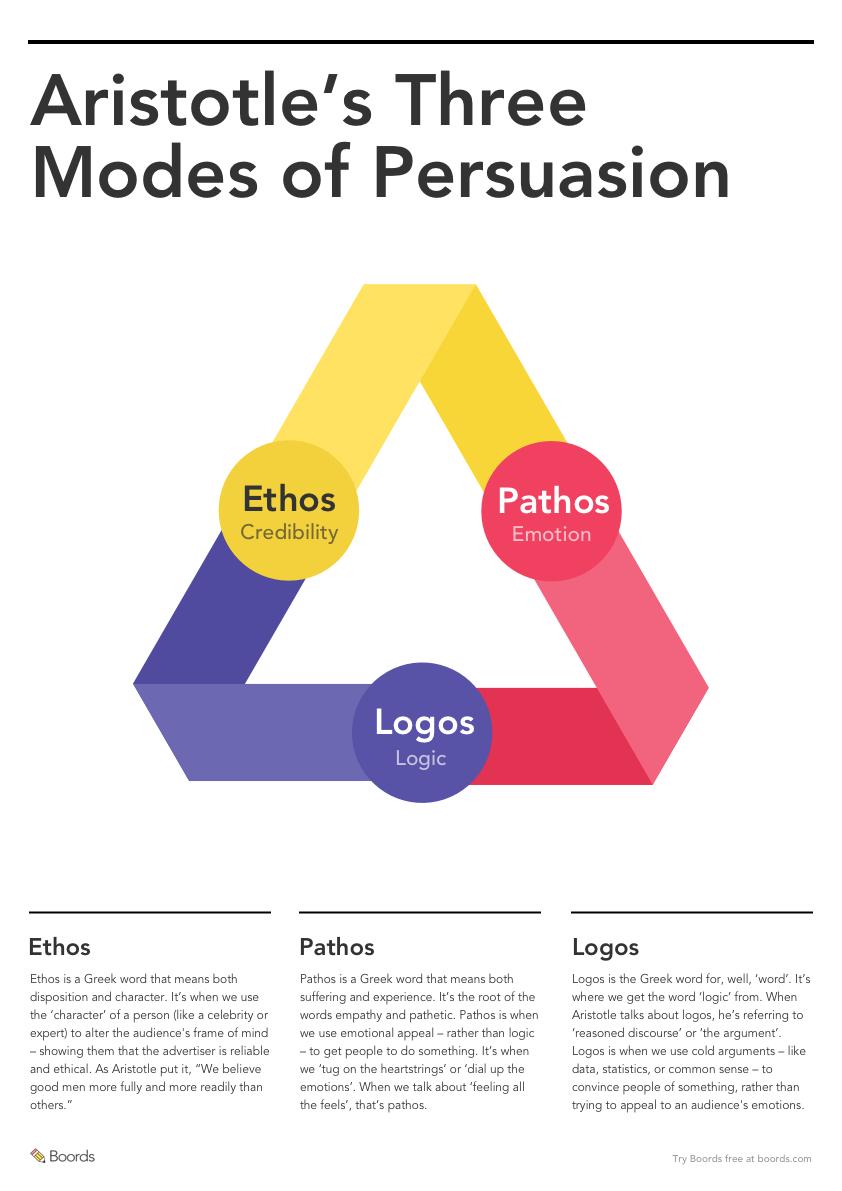


Ethos is your character as expressed by your speech. It is the effect you produce by what you say and not who you are. Your Ethos must create confidence, give you credibility.

Pathos are the emotions you create in your audience (anger, pity, fear, sympathy, etc.). 

Logos are the reasons you give for your cause, its argument. It includes both the substance of your argument and the manner of its delivery. 

The Role of Ethos in Ancient Greek Drama

Ancient Greek drama provides numerous examples of ethos, demonstrating how characters' moral and ethical frameworks drive the plot and deliver powerful messages. Here are some notable examples:

Sophocles' Antigone

In this tragedy, ethos plays a central role in the conflict between the protagonist Antigone and King Creon. Antigone's strong sense of familial duty compels her to bury her brother, defying Creon's decree. This clash between individual ethos (Antigone's loyalty to family) and state ethos (Creon's adherence to law) creates a compelling narrative that explores themes of justice, duty, and morality.

Oedipus Rex

Sophocles' Oedipus Rex demonstrates how a character's ethos can be both a strength and a weakness. Oedipus' determination to uncover the truth about his identity and save Thebes from plague showcases his strong moral character. However, his steadfastness ultimately leads to his downfall as he discovers his true identity.

The Role of the Chorus

Greek tragedies often employed the Chorus as a representation of communal ethos. The chorus served not only as narrators or commentators but also as a moral compass, reflecting societal values and norms. This collective voice provided context and commentary on the characters' actions, helping the audience understand the ethical implications of the unfolding events.

Character Construction in Greek Tragedy

The construction of characters in Greek tragedy was influenced by several factors that shaped their ethos:

1. Mythical characters: Most tragic characters were drawn from well-known myths, which limited their characterisation to established narratives.
2. Short play length: The brevity of Greek plays often resulted in characters defined by a single overriding motivation.
3. Theatrical constraints: The use of masks, large outdoor theatres, and a small number of actors influenced characters to be more formal and simple in their presentation.

Despite these constraints, Greek tragedies still managed to create complex characters with nuanced ethos. For example, Antigone, while initially defiant, begins to doubt her cause and plead for mercy as she faces execution, demonstrating a depth of character beyond a single-minded motivation.

By exploring these examples of ethos in ancient Greek drama, we can better understand how playwrights used characters' ethical frameworks to create compelling narratives and explore profound moral questions that continue to resonate with audiences today.
The Role of Pathos in Ancient Greek Drama

Ancient Greek drama frequently employed pathos to evoke strong emotions in the audience. Here are some notable examples of pathos in Greek tragedies:

Euripides' Medea

In this powerful tragedy, Euripides masterfully uses pathos to portray the emotional turmoil of the protagonist, Medea. The audience is drawn into Medea's intense suffering, evoking deep empathy and sorrow. Her anguish over her husband's betrayal and her subsequent actions create a gripping narrative that resonates with the viewers on an emotional level.

Sophocles' Oedipus Rex

Sophocles' "Oedipus Rex" is another prime example of pathos in Greek tragedy. The play's emotional core revolves around Oedipus' tragic discovery of his true identity and fate. As the truth unfolds, the audience experiences a mix of pity and fear, demonstrating how pathos can drive the narrative and create a lasting impact.

Euripides' Andromache

This play demonstrates pathos through the heart-wrenching interaction between Andromache and her son. They sing alternate strophes in anticipation of the son's imminent execution, creating a deeply moving scene that elicits strong emotions from the audience.

Euripides' Alcestis

In "Alcestis," Euripides uses pathos to portray the grief of a child. The son sings two strophes of lament, presenting a poignant picture of a child's sorrow in the face of loss. This use of pathos helps to humanise the characters and make their suffering more relatable to the audience.

Homer's Iliad

Although not a drama in the strictest sense, Homer's epic poem "The Iliad" contains elements of pathos that influenced later dramatic works. A notable example is Achilles' profound sorrow and rage following the death of his friend Patroclus. This emotional portrayal adds depth to the character and evokes strong responses from the audience.

These examples demonstrate how Greek playwrights skilfully used pathos to create emotionally charged narratives, developing characters and engaging audiences on a deeper level. By focusing on the sorrow, joy, and fear experienced by their characters, these writers brought emotional intensity to their stories, making them more relatable and full of impact. The Role of Logos in Ancient Greek Drama Logos in Ancient Greek drama refers to the use of reason, logic, and argumentation, often to persuade others, justify actions, or explore ethical and philosophical dilemmas. It is a central rhetorical and dramatic tool in Greek tragedies and comedies. Here are some notable examples of logos as used in Ancient Greek drama: 1. Antigone by Sophocles Character’s Logos: Creon uses logos to justify his decree that Polyneices should not be buried, arguing that loyalty to the state must come before familial ties. Key Moment: Creon defends his decision, stating, "The city is the king’s—it belongs to no one else." His reasoning emphasises the importance of political order and authority. Antigone’s Response: Antigone counters Creon’s argument with divine law, which she believes holds greater logical authority than human law. This clash demonstrates a conflict between competing systems of logos. 2. Oedipus Rex by Sophocles Character’s Logos: Oedipus employs logos throughout the play as he seeks to uncover the truth behind King Laius’s murder and the cause of Thebes' plague. Key Moment: Oedipus interrogates witnesses, cross-examines Tiresias, and connects the evidence systematically. His logical reasoning drives the plot, even though it leads to his tragic realisation. Tiresias’ Response: In contrast to Oedipus’ reliance on logos, Tiresias appeals to divine insight, creating a tension between human reasoning and prophetic knowledge. 3. The Oresteia by Aeschylus Character’s Logos: The trilogy culminates in a logos-driven debate in The Eumenides during the trial of Orestes. Key Moment: Athena establishes a jury to adjudicate Orestes’ case, introducing logos as the foundation for justice. Arguments are presented by both Apollo (defending Orestes) and the Furies (prosecuting him), marking the transition from personal vengeance to a rational legal system. 4. Medea by Euripides Character’s Logos: Medea uses logos to craft rational arguments that mask her emotional turmoil and manipulate others. Key Moment: Medea persuades King Creon to grant her one more day before her exile, arguing that it is a reasonable request for her to make final arrangements for her children. This logical appeal hides her true intent to exact revenge. Jason’s Logos: Jason defends his betrayal by arguing that his marriage to the Corinthian princess was a logical decision to secure a better future for his family. Medea’s counterarguments expose the flaws in his reasoning. 5. The Trojan Women by Euripides Character’s Logos: The women, particularly Hecuba, use logos to critique the logic of war and its consequences. Key Moment: Hecuba questions the rationale behind the Greeks' destruction of Troy and the enslavement of its women, presenting a reasoned condemnation of the victors’ inhumanity and hubris. 6. Lysistrata by Aristophanes Character’s Logos: Lysistrata employs logos to persuade the women and the men of Greece to adopt her peace plan. Key Moment: She uses logical reasoning to argue that prolonged war is detrimental to both sides and that a unified Greece would be more prosperous. Her appeal to shared interests helps her overcome resistance. 7. Prometheus Bound by Aeschylus Character’s Logos: Prometheus articulates a rational defense of his actions, explaining the reasoning behind his decision to give fire and knowledge to humanity. Key Moment: Prometheus argues that his foresight and logic led him to act in the interest of humanity, even though he knew it would bring Zeus’ wrath. His speeches reflect a deep engagement with logos as a justification for rebellion. 8. The Bacchae by Euripides Character’s Logos: Pentheus uses logos to dismiss Dionysus and the Bacchic cult as irrational and dangerous, attempting to rationalize his authoritarian stance. Key Moment: Pentheus argues against Dionysus’ divinity and the excesses of the Bacchic rituals, employing logic to justify his opposition. However, his rigid reliance on reason blinds him to the spiritual and emotional dimensions of the conflict. In Greek drama, logos is often presented in tension with pathos (emotional appeal) and ethos (character credibility). Playwrights use logos not just to develop characters but also to engage the audience in philosophical debates, showcasing the power and limitations of human reasoning.
References

Saturday, 28 December 2024

Ancient Greek Drama and the Evolution of Rhetoric

Origins of Rhetoric Homer

Homer's works, especially the Iliad and the Odyssey, hold an essential place in the study of rhetoric, even though they predate the formalisation of rhetorical theory by the ancient Greeks. The narratives and speeches within these epics demonstrate early examples of persuasive language, character-driven dialogue, and the power of storytelling—all of which became central concerns of rhetorical study.

Key Aspects of Rhetoric in Homer's Works:

  1. Speeches as Persuasive Tools:

    • Homer's characters frequently use speeches to persuade, motivate, or confront others. For example, in the Iliad, Achilles, Agamemnon, and Odysseus deliver emotionally charged and logically structured speeches, reflecting the use of ethos (credibility), pathos (emotion), and logos (reason), concepts later formalised by Aristotle.
  2. Ethos and Leadership:

    • Homer's heroes often establish their ethos through their words and deeds. Odysseus, in particular, is known for his cunning and rhetorical skill, demonstrating how eloquence can influence others and shape outcomes.
  3. Pathos in Emotional Appeals:

    • Many of Homer's characters appeal to emotions, such as grief, anger, or loyalty. For example, Priam’s plea to Achilles for Hector’s body in the Iliad is deeply emotional, illustrating the rhetorical power of pathos in achieving an outcome.
  4. Storytelling as a Rhetorical Act:

    • The Odyssey is rich in examples of storytelling used as persuasion. Odysseus narrates his adventures not only to entertain but also to build trust, evoke sympathy, and persuade others to assist him.
  5. Audience Awareness:

    • The epics showcase keen awareness of audience dynamics. Characters tailor their arguments depending on whether they address a king, a crowd, or an individual, reflecting early rhetorical principles of adapting to the audience.
  6. Memory and Oral Tradition:

    • Homer’s epics, rooted in oral tradition, emphasize memory and repetition—skills that are vital to classical rhetoric. The use of epithets, recurring phrases, and formulaic expressions aids the speaker in delivering and the audience in retaining the message.

Influence on Later Rhetoric:

Homer’s texts were foundational for later Greek education and rhetorical training. They were studied not only for their literary merit but also for their exemplification of effective communication and argumentation. Figures like Plato, Aristotle, and the sophists frequently referenced Homer to discuss rhetorical techniques and moral dilemmas.

In sum, while Homer himself was not a rhetorician in the formal sense, his works are imbued with rhetorical principles that have profoundly influenced the development of persuasive discourse in Western thought.

Hesiod Extract from Hesiod's Rhetorical Art by Jenny Strauss Clay in Chapter 29 of A Companion to Greek Rhetoric edited by Ian Worthington (pp.447-457) - Wiley Online Library "The handbooks tell us that rhetoric was discovered in Greece during the fifth or even fourth century and required both developed democratic and legal institutions and a literate culture to flourish, social conditions Hesiod, a near contemporary of Homer, from a small village in Boeotia could not have known. Moreover, we usually consider rhetoric to refer to speech making in prose, not Hesiod's traditional hexameter verse. Nevertheless, the Hesiodic poems share an important characteristic of oratory in its usual meaning: both are conceived as spoken performances in front of an audience. All early Greek poetry was performed orally before an audience rather than read, and the occasion of performance determined its character and genre. If we define rhetoric generally as the 'means by which a writer makes known his vision to the reader and persuades him of its validity', then the term would indeed apply to the Hesiodic poems, but it would also promiscuously embrace just about any form of literary expression. If, on the other hand, we define rhetoric as the formal study or codification of the means and rules of persuasive speech, then to speak of Hesiod's rhetoric might leave us open to the charge of gross anachronism. Yet if rhetoric means reflecting self-consciously and systematically about the power and efficacy of speech, then to speak of Hesiod's rhetoric might leave us open to the charge of gross anachronism. Yet if rhetoric means reflecting self-consciously and systematically about the power and efficacy of speech, Hesiod, I will argue, not only practised that art, but also thought about and formulated his views, not, to be sure, in a treatise, but nevertheless in a coherent manner. In fact, I would maintain ─with only a little tongue in cheek─ that Hesiod might well be considered the father of rhetoric." Ancient Greek Drama and Rhetoric The relationship between Ancient Greek Drama and Rhetoric is a complex one, with scholars offering various perspectives.
Some argue that they were intertwined from the beginning, whilst others argue that they evolved independently but influenced each other over time. Although Greek Drama may not have originated from Rhetoric there was a concurrence in their joint timing in history.
One viewpoint suggests that early Greek drama, particularly tragedy, emerged from ritualistic performances and religious ceremonies, which often involved elements of persuasion and oratory. As these performances evolved, they incorporated more elaborate speeches and dialogues, potentially influenced by the emerging art of rhetoric. Conversely, some scholars argue that Rhetoric, as a formal discipline, developed independently in the context of the law courts and political assemblies, especially in Athens. They suggest that the use of persuasive techniques in drama came later, influenced by a growing sophistication in rhetorical practices.
The evolution of Rhetoric in the late 6th century BC may have significantly influenced the development of Greek tragic drama, intertwining philosophical, political, and artistic elements to shape its structure and themes. This period, particularly in Athens, saw the rise of democratic institutions, which fostered a culture of public debate and the need to persuade people in collective situations, and the exploration of human thought and emotion.

Regardless of their origins, both Greek Drama and Rhetoric clearly coexisted and clearly influenced each other during the Classical period. The dramatic works of playwrights like Aeschylus, Sophocles, and Euripides show a masterful use of rhetorical devices, such as powerful speeches, emotional appeals, and logical arguments. These dramatic techniques, in turn, may have further popularised and a refinement in the art of Rhetoric.

The exact nature and extent of the relationship between Greek Drama and Rhetoric remain subjects of an ongoing debate between scholars. However, it is undeniable that they were both significant cultural forces in Ancient Greece, contributing to the development of literature, philosophy, and political thought.
The evolution of rhetoric in the late 6th century BC significantly influenced the development of Greek tragic drama, intertwining philosophical, political, and artistic elements to shape its structure and themes. This period, particularly in Athens, saw the rise of democratic institutions, which fostered a culture of public debate, persuasion, and the exploration of human thought and emotion.

Choral Commentary and Public Discourse

The Chorus in Greek tragedy served a rhetorical function, often mediating the action with reflective commentary that mirrored the collective voice of the community. This role was akin to the deliberative aspect of rhetoric, providing insights and judgements on the unfolding drama.

Impact of Sophists and Early Rhetoricians
The Sophists, who emerged in this period, were instrumental in formalising Rhetoric as an art of persuasion. Their emphasis on the relativity of truth and the power of language influenced tragedians to explore themes of ambiguity and conflicting perspectives. In Sophocles’ Oedipus Rex, for instance, the protagonist’s search for truth is complicated by the multiplicity of interpretations and the limits of human understanding.

The evolution of rhetoric enriched Greek tragic drama by introducing sophisticated techniques of argumentation, deepening character development, and embedding ethical and political inquiry within the narrative. Tragedy became a forum for public reflection, mirroring the intellectual and civic dynamics of its time and offering audiences a profound engagement with the complexities of human existence.

Key aspects of the influence of Rhetoric on Drama include:

Focus on Persuasion and Dialogue

Emergence of Logos (Reasoning):
The rise of rhetoric emphasised the power of logos, or reasoned speech, as a means of persuasion. This is reflected in Greek tragedies, where characters often engage in intense verbal debates, attempting to sway others or justify their actions. For example, in 'Sophocles’ Antigone, the conflicting arguments between Antigone and Creon highlight themes of individual morality versus state law.

Structure of Agon:
The rhetorical device of the agon, a structured debate between characters, became a hallmark of tragic drama. These debates demonstrated conflicting worldviews and ethical dilemmas, mirroring the intellectual rigour that was prized in Athenian democracy.

Exploration of Human Nature and Ethical Questions

Rhetoric encouraged the exploration of complex human motivations and the nature of moral choices. Tragic playwrights, influenced by rhetorical techniques, dramatised these complexities through characters torn between competing duties, desires, and social pressures. Euripides, in particular, delved deeply into the psychological dimensions of his characters, as seen in Medea and The Bacchae.

Integration of Civic and Political Themes

The rhetorical tradition was closely tied to the democratic processes of Athens, where citizens were expected to articulate their views in public assemblies and courts. Tragedies often reflected this civic engagement, using mythological narratives to comment on contemporary political and social issues. Aeschylus’ The Oresteia, for example, examines themes of justice and governance, culminating in the establishment of the court of the Areopagus.

References

(Chapter 6 Tragedy, Rhetoric, and Performance Culture by Christopher Pelling) Use of Rhetoric by the Ancient Greek Playwrights
=============== Aristotle on Rhetoric Rhetoric (Aristotle) - Wikipedia Enthymeme - Wikipedia

Enthymeme.

Aristotle's Rhetoric is one of the foundational texts of Western argumentation theory, and his treatment of both the Sophists and the enthymeme reveals a lot about what he thought rhetoric actually is — and why it deserves serious philosophical attention rather than dismissal.

Aristotle and the Sophists

Aristotle opens the Rhetoric by distancing his project from the Sophistic tradition, though the relationship is more complicated than simple rejection.

The core criticism: The Sophists (and rhetoricians in the tradition of Isocrates and others) had reduced rhetoric to a bag of tricks for winning cases — appeals to emotion, character attacks, verbal cleverness — divorced from any concern with truth. Aristotle complains that earlier writers on rhetoric had focused almost entirely on "non-essentials," particularly the arousal of prejudice, pity, and anger in the audience, treating these emotional manipulations as if they were the substance of the art rather than incidental to it. His famous line is that this is like a person who, before using a straightedge, warps it to make it usable — they distort the judge instead of proving their case.

The redefinition: Rather than rejecting rhetoric wholesale (as Plato seems to in the Gorgias), Aristotle tries to rescue it by giving it a proper philosophical foundation. He defines rhetoric as "the faculty of observing in any given case the available means of persuasion" — a neutral, analytical capacity, akin to a counterpart of dialectic. This move is central: he's arguing that rhetoric, properly understood, is a legitimate discipline concerned with modes of proof (logical, ethical, emotional — logos, ethos, pathos), not merely a Sophistic knack for deception.

Why this matters against the Sophists: For Aristotle, the Sophists' error was treating rhetoric as fundamentally about winning through any means, including exploiting the weaknesses of the audience or the legal system. He argues instead that rhetoric is useful precisely because truth and justice are naturally stronger than their opposites — if verdicts go wrong, it's the fault of the speakers, not the art itself. He also insists that rhetoric can be abused to do harm, but that this is true of nearly every good thing (strength, wealth, generalship) except virtue itself — so the fault lies with the user, not the discipline. This is a direct rebuttal to critics (following Plato) who saw rhetoric as inherently sophistic and corrupting.

The Enthymeme

The enthymeme is arguably Aristotle's most original and important contribution in the Rhetoric, and he calls it "the body of proof" — the substance of rhetorical demonstration.

Definition and structure: An enthymeme is essentially a rhetorical syllogism. It follows the logical form of a syllogism but operates in the realm of probability and generally accepted premises (endoxa) rather than certain, scientific premises. Because rhetorical audiences are dealing with contingent matters — human affairs, ethics, politics — rather than necessary truths, the enthymeme draws conclusions that are probable, not demonstratively certain.

Compression: A key structural feature is that enthymemes are typically compressed syllogisms — one premise (often the major premise, if it's something the audience already believes) is left unstated because it's assumed to be shared common knowledge. For example: "Since he's a politician, he's probably not to be trusted" suppresses the premise "politicians are generally untrustworthy" because it's an assumption the audience already holds. This omission isn't a flaw — it's rhetorically effective, because the audience participates by mentally supplying the missing premise, which makes the argument feel more like their own conclusion than an imposed one.

Enthymemes vs. syllogisms: Aristotle distinguishes enthymemes from strict logical syllogisms in that they work from premises that are merely probable or generally accepted (endoxa) and from signs (semeia) rather than from premises that are necessarily true. He also identifies "fallacious enthymemes" — arguments that have the form of a proper enthymeme but rest on faulty or merely apparent probabilities, which connects back to his critique of the Sophists, since much sophistic argument relies on this kind of specious reasoning.

Sources of enthymemes — the topoi: Aristotle catalogs "topics" (topoi), which are general lines of argument or strategies from which enthymemes can be constructed — such as arguments from opposites, from degree (more/less), from cause and effect, from correlative relations, and so on. These function as a kind of toolkit for inventing persuasive arguments in any subject matter, which is part of why he thinks rhetoric is a genuine art (technÄ“) — it has teachable, systematic content rather than being pure natural talent or trickery, as the Sophists' practice sometimes implied.

Connection to the anti-Sophist argument: The enthymeme is doing real philosophical work for Aristotle: by grounding rhetoric in a form of reasoning (however probabilistic), he's showing that persuasion can be rational and even quasi-scientific, rather than the manipulative, emotion-driven performance the Sophists were accused of peddling. This is his answer to Plato's charge that rhetoric is a mere "knack" (empeiria) rather than a proper art (technÄ“) — because it has a logical backbone in the enthymeme, rhetoric qualifies as a discipline with real cognitive content.


Ethos, Pathos, and Logos in Relation to the Enthymeme

Aristotle identifies three modes of persuasion (pisteis), and the enthymeme is specifically the vehicle for logos, though it doesn't operate in isolation from the other two.

Logos (the argument itself): The enthymeme is the primary instrument of logical proof. Aristotle ranks it as the most important of the three modes because it appeals to the audience's reasoning rather than their emotions or their opinion of the speaker's character. He treats a well-constructed enthymeme as capable of persuading almost independently of who delivers it — a claim that reflects his more "scientific" ambitions for rhetoric.

Ethos (character): Interestingly, Aristotle says the speaker's perceived character — practical wisdom, virtue, and goodwill toward the audience — is often the most effective means of persuasion, sometimes more so than the argument itself. But this isn't disconnected from the enthymeme: a speaker can construct enthymemes that indirectly display good character (choices of examples, the values assumed in suppressed premises) so that ethos is partly generated through the reasoning process, not just through reputation or delivery.

Pathos (emotion): Aristotle devotes substantial space (in Book II) to a systematic analysis of emotions — anger, calm, love, fear, shame, pity, indignation, envy — because he thinks a speaker needs precise understanding of what causes these states, toward whom, and under what circumstances, in order to construct enthymemes that naturally evoke the appropriate emotional disposition in the audience as part of the argument, rather than as a manipulative add-on. This is his rehabilitation of pathos against the Sophistic version: emotional appeal, done properly, is knowledge-based — it depends on understanding human psychology accurately, not just pulling levers.

The enthymeme, then, is the connective tissue: a well-built enthymeme can simultaneously carry logical force, reflect well on the speaker's character, and be calibrated to the audience's emotional state — which is why Aristotle treats it as "the body" of rhetorical proof rather than just one tool among several.

The Topoi (Topics)

Aristotle's topoi are patterns or "places" (literally, "places" one goes to find arguments) from which enthymemes can be generated. He divides these into:

Common topics (koinoi topoi) — usable across all three genres of rhetoric (deliberative, forensic, epideictic):

From opposites: if the opposite of a predicate holds a certain relation, argue the predicate does too (e.g., "if temperance is beneficial, then excess is harmful")

From degree (more and less): if something isn't true of a stronger/more likely case, it isn't true of a weaker one, and vice versa

From correlative terms: if one relational term applies, examine whether its correlate does too (e.g., if it was just for X to act, was it just for Y to suffer it?)

From cause to effect and effect to cause

From consideration of time: what is consistent or inconsistent with earlier statements/actions

From definition: unpacking what something essentially is to draw conclusions

Special topics (idia): These are subject-specific — arguments proper to ethics, politics, or particular subject matters, rather than general logical strategies.

Fallacious/spurious topics: Aristotle also catalogs "apparent enthymemes" that mimic legitimate topics but rest on faulty reasoning — such as arguing from mere verbal similarity, treating a sign as necessarily conclusive when it's only probable, or confusing sequence with causation. This section functions as a direct rebuke to Sophistic technique, since he's essentially cataloging the tricks used by unscrupulous speakers so that both speakers and audiences can recognize when persuasion has slipped from legitimate probability-based reasoning into deceptive form.

The overall architecture is elegant: the topoi are the generative machinery, the enthymeme is the resulting product, and ethos/pathos/logos describe the different dimensions along which that product does its persuasive work. It's Aristotle's attempt to turn what the Sophists treated as an improvisational, opportunistic skill into a systematic art with teachable structure — logic applied to the contingent world of human affairs rather than to necessary truths.

Want me to look at how this framework gets applied in Book II's discussion of specific emotions, or how later rhetorical tradition (Cicero, Quintilian) responded to Aristotle's enthymeme concept? Origin of Rhetoric

Rhetoric may be defined as the art of persuasion, and it has historically existed in a state of tension with the pursuit of truth. For Aristotle, the principal currencies of rhetoric were probability and value judgments, while its primary instrument was argumentation.

Rhetoric subsequently became an established subject of pedagogical instruction. Its applications have been manifold: it contributed to the formation of modern English prose style (as exemplified by Shakespeare), it was mobilized to galvanize national resolve against external threats (as in the oratory of Winston Churchill), and it continues to serve the more modest function of enabling more effective interpersonal communication. For those seeking to understand the subtle mechanisms by which hearts and minds are won—and, by extension, how influence within the public sphere is acquired and exercised—the study of rhetoric offers considerable insight.

The origins of rhetoric may be traced to Ancient Greece, and specifically to the highly litigious civic life of the polis. Within this context, the preeminent form of leadership was that of the political orator, and the discipline governing this practice was designated rhetorikē technē. This art was first systematically advanced by Gorgias of Leontini, a Sicilian sophist renowned for his Encomium of Helen, a speech composed in defence of Helen of Troy against the charge of her having precipitated the Trojan War. In this work, Gorgias considers several possible explanations for Helen's departure with Paris, ultimately concluding that she acted under compulsion and was therefore undeserving of the opprobrium subsequently directed at her. Although the Encomium did not succeed in rehabilitating Helen's reputation, it has endured as a paradigmatic demonstration of rhetoric's persuasive power.

This illustrates how speech, when skillfully composed, may act upon the mind in a manner analogous to the action that a drug has upon the body.

The recognition of rhetoric's capacity to alter cognition and belief prompted Plato (c. 428–347 BC) — the student of Socrates and teacher of Aristotle — to mount a sustained polemic against the discipline. His dialogue Gorgias inaugurated this campaign. There Plato disputed the Sophists' claim that rhetoric constitutes a genuine art (techne), contending that it is not a form of knowledge at all, but rather a kind of facility or practical skill with language acquired through mere experience (empeiria), lacking any grounding in rational principle. This argument was directed specifically at Gorgias' historical position that effective statesmanship required no specialized knowledge beyond rhetorical competence. In a further, self-consciously rhetorical manoeuver, Plato likens rhetoric to cosmetics and cookery, characterising all three as forms of flattery (kolakeia) oriented toward the gratification of an uninformed audience rather than toward its genuine benefit. Only Philosophy — realised through the Socratic dialectic — is capable of offering sound counsel regarding the good of the Polis, and is therefore, on Plato's account, the only legitimate political art.
His dialogue (Gorgias) inaugurated the long-standing quarrel between philosophy has had with Rhetoric, in which the latter has ever since been compelled to bear the stigma of Sophistry (fallacious or misleading argumentation).