Hephaistia - Wikipedia
Thursday, 10 September 2015
Wednesday, 9 September 2015
Greek Vase Painting
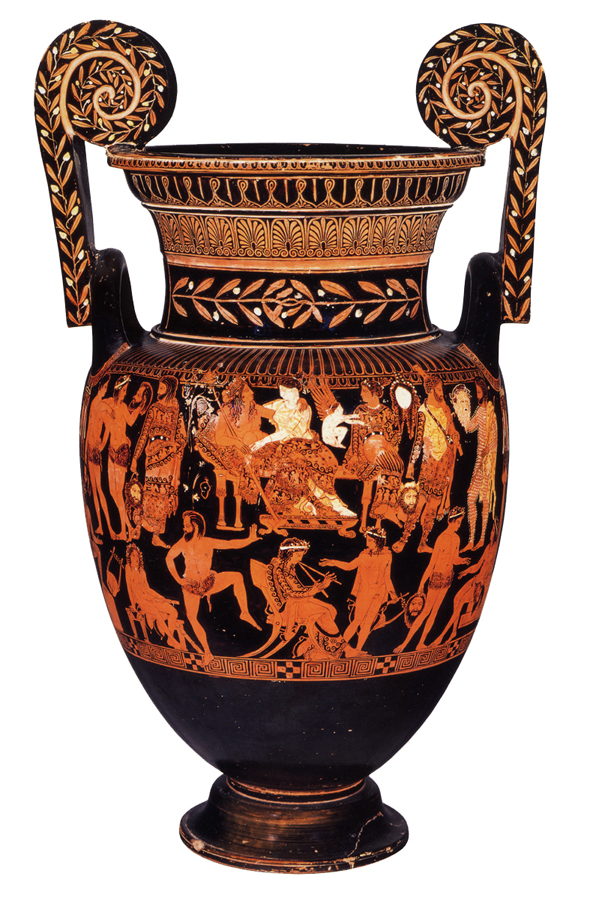
Around 530-520 bc a technical revolution in Athenian vase-painting occurred. The new technique was red-figure, and it would come to dominate Greek vase-painting over the next two centuries, covering the classical period of Greek drama. The scenes depicted on the vases of this period can be sometimes extremely important primary historical evidence as to how the Ancient Greeks staged their dramas.
Before 530 bc the dominant technique was black-figure. In the case of black-figure painting figures are seen as a black silhouette depicted against the natural orange colour of the clay used in the vase. Details are created by cutting through the black surface using a sharp engraving tool. Red-figure is the reversal of this technique: figures are left behind in the orange colour of the clay, whilst the background is coloured in black around them; details are added afterwards using a brush.
Red-figure was the more flexible, as different size brushes could be used, which when combined with different thicknesses in the glazing these generate different kinds of line, and look more natural than the lines created using the engraving tool. If the artists combined the two techniques on the same vase such vases are termed "bilingual".
The scenes depicted on the vases of this period can be sometimes extremely important primary evidence as to how the Ancient Greeks staged their dramas.
The Names of Some Shapes
Kylix = A shallow drinking cup with two handles
Amphora = A two-handled jar used for holding or storing liquids with a neck narrower than the body
Krater = A wide mouthed vessel used for mixing wine with water.
Oinochoe = A single-handled jug typically taller than it is wide, used for pouring wine.
Hydria = A water carrying vessel with three handles, two for carrying and one for pouring
Lekythos = A flask used for storing olive oil.
A Dictionary of the Ancient Greek World p. 194- Pottery: David Sacks - Internet Archive
Pronomos Vase
A Dictionary of the Ancient Greek World p. 194- Pottery: David Sacks - Internet Archive
Pronomos Vase
Beazley ARV 1336.1 Museo Archeologico Nazionale di Napoli No. 3240H
Oliver Taplin; Rosie Wyles (2010). The Pronomos Vase and its Context. OUP Oxford. ISBN 978-0-19-958259-4.
Mark Griffith (2015). Greek Satyr Play: Five Studies. The Pronomos Vase: California Classical Studies. pp. 135–. ISBN 978-1-939926-05-0.
http://www.perseus.tufts.edu/hopper/artifact?name=Naples+3240&object=vase
http://www.beazley.ox.ac.uk/record/3D02875A-C39F-47EC-B0C3-396D004855C7
http://cir.campania.beniculturali.it/museoarcheologiconazionale/thematic-views/image-gallery/RA84/view
The Art of Ancient Greek Theater - Mary Louise Hart, J. Michael Walton - Google Books
Understanding Greek Vases: A Guide to Terms, Styles, and Techniques - Andrew J. Clark, Maya Elston, Mary Louise Hart - Google Books
Monuments illustrating old and middle comedy : Webster, T. B. L. - Internet Archive
The Art of Ancient Greek Theater - Mary Louise Hart, J. Michael Walton - Google Books
Understanding Greek Vases: A Guide to Terms, Styles, and Techniques - Andrew J. Clark, Maya Elston, Mary Louise Hart - Google Books
Monuments illustrating old and middle comedy : Webster, T. B. L. - Internet Archive
Copenhagen Krater Vase Red-Figure
Bell Krater Vase Red-Figure
Decoration:
A: Theatrical, Dithyramb, Chorus, Draped Men Singing, and Youth Playing Pipes, Post With Ivy
B: Draped Satyr With Torch, Women (Maenads) With Thyrsos
References
Illustrations of Greek drama : Trendall, A. D. - Internet Archive
Études sur la tragédie grecque dans ses rapports avec la céramique : Séchan, L. (Louis) - Internet Archive
The History of Greek Vases : potters, painters, and pictures: Boardman, John - Internet Archive
Greek Vase-Painting and the Origins of Visual Humour - Google Books
Greek vase-painting and the origins of visual humour : Mitchell, Alexandre G. - Internet Archive
The Comic Body in Ancient Greek Theatre and Art, 440-320 BCE - Google Books
Figures of Speech : men and maidens in ancient Greece: Ferrari, Gloria - Internet Archive
Illustrations of Greek drama : Trendall, A. D. - Internet Archive
Études sur la tragédie grecque dans ses rapports avec la céramique : Séchan, L. (Louis) - Internet Archive
The History of Greek Vases : potters, painters, and pictures: Boardman, John - Internet Archive
Greek Vase-Painting and the Origins of Visual Humour - Google Books
Greek vase-painting and the origins of visual humour : Mitchell, Alexandre G. - Internet Archive
The Comic Body in Ancient Greek Theatre and Art, 440-320 BCE - Google Books
Figures of Speech : men and maidens in ancient Greece: Ferrari, Gloria - Internet Archive
A catalogue of the Greek vases in the Fitzwilliam Museum, Cambridge: Fitzwilliam Museum - Internet Archive
Catalogue of the Greek vases in the Ashmolean Museum: Ashmolean Museum - Internet Archive
Shapes of Greek Vases: Metropolitan Museum of Art (New York, N.Y.) - Internet Archive
Internet Archive: Digital Library of Free & Borrowable Books, Movies, Music & Wayback Machine
Search: Catalog+Greek+Vases+Metropolitan+Museum
Weiss, N. (2023). Seeing Theater: The Phenomenology of Classical Greek Drama (1st ed.). University of California Press. https://doi.org/10.2307/jj.1895852
Seeing Theater: The Phenomenology of Classical Greek Drama on JSTOR
Geometry of Greek vases; Attic vases in the Museum of Fine Arts analysed according to the principles of proportion discovered by Jay Hambidge : Caskey, Lacey D - Internet Archive
TRENDALL, A. D. (1959). PHLYAX VASES. Bulletin Supplement (University of London. Institute of Classical Studies), 8, i–77. http://www.jstor.org/stable/43768419
Internet Archive: Digital Library of Free & Borrowable Books, Movies, Music & Wayback Machine
Search: Catalog+Greek+Vases+Metropolitan+Museum
Weiss, N. (2023). Seeing Theater: The Phenomenology of Classical Greek Drama (1st ed.). University of California Press. https://doi.org/10.2307/jj.1895852
Seeing Theater: The Phenomenology of Classical Greek Drama on JSTOR
Geometry of Greek vases; Attic vases in the Museum of Fine Arts analysed according to the principles of proportion discovered by Jay Hambidge : Caskey, Lacey D - Internet Archive
TRENDALL, A. D. (1959). PHLYAX VASES. Bulletin Supplement (University of London. Institute of Classical Studies), 8, i–77. http://www.jstor.org/stable/43768419
TRENDALL, A. D. (1967). PHLYAX VASES (Second edition, revised and enlarged). Bulletin Supplement (University of London. Institute of Classical Studies), 19, iii–116. http://www.jstor.org/stable/43768296
Dearden, C. W. (1995). POTS, TUMBLERS AND PHLYAX VASES. Bulletin of the Institute of Classical Studies. Supplement, 66, 81–86. http://www.jstor.org/stable/43767990
Pots & Plays: Interactions Between Tragedy and Greek Vase-Painting of the ... - Oliver Taplin - Google Books
Images of the Greek theatre by Green, John Richard - Internet Archive
Images of the Greek theatre : Green, J. R. (John Richard) - Internet Archive
Greek Vases in The J. Paul Getty Museum: Volume 1 (OPA 1)
Greek Vases in The J. Paul Getty Museum: Volume 2 (OPA 3)
Greek Vases in The J. Paul Getty Museum: Volume 3 (OPA 2)
Greek Vases in The J. Paul Getty Museum: Volume 4 (OPA 5)
Greek Vases in The J. Paul Getty Museum: Volume 5 (OPA 7)
Greek Vases in The J. Paul Getty Museum: Volume 6 (OPA 9)
The Amasis Painter and His World: Vase Painting in Sixth-Century B.C. Athens
Pottery of ancient Greece - Wikipedia
The Context of Ancient Drama - Plates: Eric Csapo and William J. Slater - Internet Archive
Images of the Greek theatre by Green, John Richard - Internet Archive
Images of the Greek theatre : Green, J. R. (John Richard) - Internet Archive
Greek Vases in The J. Paul Getty Museum: Volume 1 (OPA 1)
Greek Vases in The J. Paul Getty Museum: Volume 2 (OPA 3)
Greek Vases in The J. Paul Getty Museum: Volume 3 (OPA 2)
Greek Vases in The J. Paul Getty Museum: Volume 4 (OPA 5)
Greek Vases in The J. Paul Getty Museum: Volume 5 (OPA 7)
Greek Vases in The J. Paul Getty Museum: Volume 6 (OPA 9)
The Amasis Painter and His World: Vase Painting in Sixth-Century B.C. Athens
Pottery of ancient Greece - Wikipedia
The Context of Ancient Drama - Plates: Eric Csapo and William J. Slater - Internet Archive
Three-phase firing - Wikipedia
Leonard Whibley. A Companion to Greek Studies (IV.5 Vase Painting). Cambridge University Press. pp. 333–47. ISBN 978-1-107-49754-2.
John Davidson Beazley (1951). The Development of Attic Black-figure. University of California Press. ISBN 978-0-520-05593-3.
Greek tragedy in the light of vase paintings : Huddilston, John Homer, 1869 - Internet Archive
A catalogue of the Greek and Etruscan vases in the British Museum Volume II : British Museum. Dept. of Greek and Roman Antiquities - Internet Archive
Explore the British Museum Collection
Oliver Taplin (28 January 1993). Comic Angels and Other Approaches to Greek Drama through Vase-Paintings. Clarendon Press. ISBN 978-0-19-158865-5.
Comic Angels and Other Approaches to Greek Drama through Vase-Paintings Archive.org
Edith Hall (10 January 2013). Adventures with Iphigenia in Tauris: A Cultural History of Euripides' Black Sea Tragedy. Chapter 4; Pots and Plots - The Fourth-century popularity of Iphigenia in Tauris: OUP USA. pp. 69–. ISBN 978-0-19-539289-0.
Tom B. Rasmussen (26 July 1991). Looking at Greek Vases. Chapter 7: Farce and tragedy in South Italian vase-painting: Cambridge University Press. pp. 151–. ISBN 978-0-521-37679-2.
Robin Osborne (6 February 2018). The Transformation of Athens: Painted Pottery and the Creation of Classical Greece. Princeton University Press. ISBN 978-0-691-17767-0.
John H. Oakley; Olga Palagia (1 May 2009). Athenian Potters and Painters Volume II. Oxbow Books. ISBN 978-1-78297-322-5.
John Oakley (31 August 2014). Athenian Potters and Painters Volume III. Oxbow Books. ISBN 978-1-78297-666-0.
A catalogue of the Greek and Etruscan vases in the British Museum Volume II : British Museum. Dept. of Greek and Roman Antiquities - Internet Archive
Explore the British Museum Collection
Oliver Taplin (28 January 1993). Comic Angels and Other Approaches to Greek Drama through Vase-Paintings. Clarendon Press. ISBN 978-0-19-158865-5.
Comic Angels and Other Approaches to Greek Drama through Vase-Paintings Archive.org
Edith Hall (10 January 2013). Adventures with Iphigenia in Tauris: A Cultural History of Euripides' Black Sea Tragedy. Chapter 4; Pots and Plots - The Fourth-century popularity of Iphigenia in Tauris: OUP USA. pp. 69–. ISBN 978-0-19-539289-0.
Tom B. Rasmussen (26 July 1991). Looking at Greek Vases. Chapter 7: Farce and tragedy in South Italian vase-painting: Cambridge University Press. pp. 151–. ISBN 978-0-521-37679-2.
Robin Osborne (6 February 2018). The Transformation of Athens: Painted Pottery and the Creation of Classical Greece. Princeton University Press. ISBN 978-0-691-17767-0.
John H. Oakley; Olga Palagia (1 May 2009). Athenian Potters and Painters Volume II. Oxbow Books. ISBN 978-1-78297-322-5.
John Oakley (31 August 2014). Athenian Potters and Painters Volume III. Oxbow Books. ISBN 978-1-78297-666-0.
Arthur Dale Trendall; Thomas Bertram Lonsdale Webster (1971). Illustrations of Greek drama. Phaidon. ISBN 978-0-7148-1492-6.
Martin Robertson (1992). The Art of Vase-Painting in Classical Athens. Cambridge University Press. pp. 1–. ISBN 978-0-521-33881-3.
Mary Louise Hart (2010). The Art of Ancient Greek Theater. Getty Publications. ISBN 978-1-60606-037-7.
N. K. Rutter; Brian A. Sparkes (2000). Word and Image in Ancient Greece. Edinburgh University Press. ISBN 978-0-7486-1405-9.
Pat Easterling; Edith Hall (2002). Greek and Roman Actors: Aspects of an Ancient Profession. Cambridge University Press. pp. 93–. ISBN 978-0-521-65140-0.
Mary Louise Hart; J. Michael Walton; J. Paul Getty Museum (2010). The Art of Ancient Greek Theater. Getty Publications. ISBN 978-1-60606-037-7.
John Boardman (2006). The History of Greek Vases: Potters, Painters and Pictures. Thames & Hudson. ISBN 978-0-500-28593-0.
R. M. Cook (2013). Greek Painted Pottery. Routledge. ISBN 978-1-135-63684-5.
CVA - Corpus Vasorum Antiquorum
Dietrich Von Bothmer (1987). Greek Vase Painting. Metropolitan Museum of Art. ISBN 978-0-87099-488-3.
Oliver Taplin (2007). Pots & Plays: Interactions Between Tragedy and Greek Vase-Painting of the Fourth Century B.C. Getty Publications. ISBN 978-0-89236-807-5.
E. Buschor. Greek vase-painting. Рипол Классик. ISBN 978-5-87512-938-4.
Andrew J. Clark; Maya Elston; Mary Louise Hart (2002). Understanding Greek Vases: A Guide to Terms, Styles, and Techniques. Getty Publications. ISBN 978-0-89236-599-9.
CVA - Corpus Vasorum Antiquorum
Dietrich Von Bothmer (1987). Greek Vase Painting. Metropolitan Museum of Art. ISBN 978-0-87099-488-3.
Oliver Taplin (2007). Pots & Plays: Interactions Between Tragedy and Greek Vase-Painting of the Fourth Century B.C. Getty Publications. ISBN 978-0-89236-807-5.
E. Buschor. Greek vase-painting. Рипол Классик. ISBN 978-5-87512-938-4.
Andrew J. Clark; Maya Elston; Mary Louise Hart (2002). Understanding Greek Vases: A Guide to Terms, Styles, and Techniques. Getty Publications. ISBN 978-0-89236-599-9.
Greek Theatre on Vases and in History
Arthur Dale Trendall; Thomas Bertram Lonsdale Webster (1971). Illustrations of Greek drama. Phaidon. ISBN 978-0-7148-1492-6.
A handbook of Attic red-figured vases signed by or attributed to the various masters of the sixth and fifth centuries B. C Volume 1: Hoppin, Joseph Clark - Internet Archive
A handbook of Attic red-figured vases signed by or attributed to the various masters of the sixth and fifth centuries B. C. Volume 2: Hoppin, Joseph Clark - Internet Archive
The Siracusa Tragedy-Vase: Oedipus and his Daughters? by Oliver Taplin
Arthur Dale Trendall; Thomas Bertram Lonsdale Webster (1971). Illustrations of Greek drama. Phaidon. ISBN 978-0-7148-1492-6.
A handbook of Attic red-figured vases signed by or attributed to the various masters of the sixth and fifth centuries B. C Volume 1: Hoppin, Joseph Clark - Internet Archive
A handbook of Attic red-figured vases signed by or attributed to the various masters of the sixth and fifth centuries B. C. Volume 2: Hoppin, Joseph Clark - Internet Archive
Author(s): Axel Seeberg
Source: Bulletin of the Institute of Classical Studies. Supplement, No. 66, Stage Directions:
Essays in Ancient Drama in Honour of E. W. Handley (1995), pp. 1-12
Published by: Wiley
Stable URL: https://www.jstor.org/stable/43767984
CORINTHIAN KOMOS VASES
Author(s): Axel Seeberg
Source: Bulletin Supplement (University of London. Institute of Classical Studies), No. 27,
CORINTHIAN KOMOS VASES (1971), pp. iii, v, vii, ix-xi, xiii-xv, 1-11, 13-55, 57-107
Published by: Wiley
Stable URL: https://www.jstor.org/stable/43768428
Visual Language and Concepts of Cult on the "Lenaia Vases"
Sarah Peirce
Classical Antiquity
Vol. 17, No. 1 (Apr., 1998), pp. 59-95 (46 pages)
Published by: University of California Press
DOI: 10.2307/25011074
https://www.jstor.org/stable/25011074
Eric Csapo; Margaret C. Miller (2007). The Origins of Theater in Ancient Greece and Beyond: From Ritual to Drama. Cambridge University Press. pp. 1–. ISBN 978-0-521-83682-1.
Shapes of Greek vases - Metropolitan Museum of Art (New York, N.Y.)
Looking at Greek Vases - Google Books
Looking at Greek vases - Internet Archive
Lekythos - Wikipedia
Hambridge Greek Vase | PDF
The new choregos vase - Persée
Audio/Visual
LaunchPad: Ancient Greek Vase Production and the Black-Figure Technique - YouTube
Attic Vases part one | PRECIOUS EARTH - YouTube
Attic Vases part two | MATERIALS AND TECHNIQUES - YouTube
Attic Vases part three | THREE - STAGE FIRING - YouTube
Dynamic symmetry; the Greek vase - Wikimedia Commons
Hambridge Greek Vase | PDF
The new choregos vase - Persée
Audio/Visual
LaunchPad: Ancient Greek Vase Production and the Black-Figure Technique - YouTube
Attic Vases part one | PRECIOUS EARTH - YouTube
Attic Vases part two | MATERIALS AND TECHNIQUES - YouTube
Attic Vases part three | THREE - STAGE FIRING - YouTube
Sunday, 6 September 2015
Choregos [χορηγός]
Plural: choregia or khoregia
The very richest or citizens [sometimes rich metics] from the very highest classes of the Athenian city state [polis] were required by the Athenian Constitution, when called upon by the Eponymous Archon to do so, to carry out a specific public service and civic duty at their own expense. This was known as a performing a "liturgy". This might be to command and maintain one of the ships in the Athenian navy, or to fund a chorus for one of the several Athenian festivals, or whatever public service the city state or polis required.
A poet who wished to put on a play [typically 4 plays required for a tragic production] went before a magistrate of the Athenian polis, , the Archon Basileus, head of the religious festivals who asked for a chorus. If he was granted his request, a wealthy citizen was assigned by the Eponymous Archon to be choregos, the financial sponsor of the project. The poet became didaskalos or "trainer" of the chorus, with the state paying for the poet [playwright] and the aulos players or auletes (αὐλητής) , and the actors or hypokritēs (ὑποκριτής).
Those nominated were compulsorily required to perform this service. One could escape this duty if could find a richer person than oneself who seemingly hadn't taken up this duty and claim in court that they had been passed over for nomination. This was known as antidosis [exchange of property], a legal form by which a citizen charged to perform a leitourgia might call upon the other citizen, whom he thought richer than himself, either to exchange all the property that each owned with each other, or to submit to the performance of the leitourgia himself.
The very richest or citizens [sometimes rich metics] from the very highest classes of the Athenian city state [polis] were required by the Athenian Constitution, when called upon by the Eponymous Archon to do so, to carry out a specific public service and civic duty at their own expense. This was known as a performing a "liturgy". This might be to command and maintain one of the ships in the Athenian navy, or to fund a chorus for one of the several Athenian festivals, or whatever public service the city state or polis required.
A poet who wished to put on a play [typically 4 plays required for a tragic production] went before a magistrate of the Athenian polis, , the Archon Basileus, head of the religious festivals who asked for a chorus. If he was granted his request, a wealthy citizen was assigned by the Eponymous Archon to be choregos, the financial sponsor of the project. The poet became didaskalos or "trainer" of the chorus, with the state paying for the poet [playwright] and the aulos players or auletes (αὐλητής) , and the actors or hypokritēs (ὑποκριτής).
Those nominated were compulsorily required to perform this service. One could escape this duty if could find a richer person than oneself who seemingly hadn't taken up this duty and claim in court that they had been passed over for nomination. This was known as antidosis [exchange of property], a legal form by which a citizen charged to perform a leitourgia might call upon the other citizen, whom he thought richer than himself, either to exchange all the property that each owned with each other, or to submit to the performance of the leitourgia himself.
In Athens for all the great festivals, such as the Greater Dionysia, the Thargelia, and the Panathenaia, each tribe was required to put forward one of its wealthier members to act as its choregos [sponsor of a chorus] as a leitourgia for the tribe. The duties of a choregos were to supply, suitably costume and equip, and organize suitable training grounds for the members of a chorus [choreutai] at his own expense to represent their tribe. The choregos has to find the money to feed, house, and train the chorus during rehearsal time. The choruses from the ten tribes of Athens then competed against each other at these festivals. Very great honour or kudos was bestowed upon the choregos of the winning team.
Some very well known persons in classical Athens acted at one time or other as choregos. For example, Perikles was the choregos for and underwrote the cost of the first production of Aeschylus' Persians in 472 bc. And also Plato acted as a choregos at one time.
References
Definition of the word Liturgy
The word liturgy, derived from the technical term in ancient Greek (Greek: λειτουργία), leitourgia, which literally means "work for the people" is a literal translation of the two words "litos ergos" or "public service".
Choregos - Wikipedia
1911 Encyclopædia Britannica/Choragus - Wikisource
Chorēgia - Oxford Reference
Chorēgia - Oxford Reference Oxford Classical Dictionary
Eponymous archon - Wikipedia
Coryphaeus - Wikipedia
https://en.m.wikipedia.org/wiki/Archon_basileus?wprov=sfla1
Theorika in Fifth-Century Athens - CORE
Peter Wilson (18 September 2003). The Athenian Institution of the Khoregia: The Chorus, the City and the Stage. Cambridge University Press. ISBN 978-0-521-54213-5.
The Athenian institution of the Khoregia: the chorus, the city and the stage
Aristotle. The Athenian Constitution. Part 56: Start Publishing LLC. pp. 48–. ISBN 978-1-62558-335-2.
The Athenian Constitution - Chapter 56
Henry George Liddell, Robert Scott, A Greek-English Lexicon, χορηγ-ός
Simon Hornblower; Antony Spawforth; Esther Eidinow (2012). The Oxford Classical Dictionary. Choregos OUP Oxford. pp. 311–. ISBN 978-0-19-954556-8.
At Athens the chorēgia was a leitourgia (liturgy), or public service performed by a wealthy citizen for the polis. A chorēgos (literally ‘leader of a chorus’) was responsible for the recruitment, training, maintenance, and costuming of choreutai (members of a chorus) for competitive performance at a festival. The same system of individual contribution was used to provide the Athenian navy with its ships (trierarchia: see trierarchy).The chorēgia was central to the organization and funding of the dramatic festivals in Athens and its demes. The actors were appointed and remunerated separately by the polis, but the chorus involved the main part of the expense in these productions. In the Great Dionysia, the main dramatic festival held annually, choruses were required for each of the various genres of performance: five for comedy (with 24 choreutai in each), three for tragedy and satyr-play (see satyric drama) (12 or 15 choreutai) and ten each for the two categories of dithyramb, men's and boys’ (50 choreutai)
Marc G. de Santis (30 April 2017). A Naval History of the Peloponnesian War: Ships, Men and Money in the War at Sea, 431-404 BC. Pen & Sword Books. ISBN 978-1-4738-6160-2.
Eric Csapo; William J. Slater (1995). The Context of Ancient Drama. The Choregic System: University of Michigan Press. pp. 139–. ISBN 0-472-08275-2.
Discoveries in the Attic Deme of Ikaria 1888. III. The Choregia in Athens and at Ikaria
Jill Frank (2005). A Democracy of Distinction: Aristotle and the Work of Politics. University of Chicago Press. pp. 62–. ISBN 978-0-226-26019-8.
Peter Wilson (2003). The Athenian Institution of the Khoregia: The Chorus, the City and the Stage. Cambridge University Press. ISBN 978-0-521-54213-5.
A Companion to Greek Studies. § 515 Liturgies: CUP Archive. 1905. pp. 495–. Liturgies- A Companion to Greek Studies §§ 515
A Companion to Greek Studies (4th Edition ed.). VI - Financing the Greek City States (incl. Liturgies): CUP Archive. 1931. pp. 491–. §§ 511-21
J. K. Davies
The Journal of Hellenic Studies
Vol. 87 (1967), pp. 33-40
Published by: The Society for the Promotion of Hellenic Studies
DOI: 10.2307/627805
https://www.jstor.org/stable/627805
At Athens the chorēgia was a leitourgia (liturgy), or public service performed by a wealthy citizen for the polis. A chorēgos (literally ‘leader of a chorus’) was responsible for the recruitment, training, maintenance, and costuming of choreutai (members of a chorus) for competitive performance at a festival. The same system of individual contribution was used to provide the Athenian navy with its ships (trierarchia: see trierarchy).The chorēgia was central to the organization and funding of the dramatic festivals in Athens and its demes. The actors were appointed and remunerated separately by the polis, but the chorus involved the main part of the expense in these productions. In the Great Dionysia, the main dramatic festival held annually, choruses were required for each of the various genres of performance: five for comedy (with 24 choreutai in each), three for tragedy and satyr-play (see satyric drama) (12 or 15 choreutai) and ten each for the two categories of dithyramb, men's and boys’ (50 choreutai)
Marc G. de Santis (30 April 2017). A Naval History of the Peloponnesian War: Ships, Men and Money in the War at Sea, 431-404 BC. Pen & Sword Books. ISBN 978-1-4738-6160-2.
Eric Csapo; William J. Slater (1995). The Context of Ancient Drama. The Choregic System: University of Michigan Press. pp. 139–. ISBN 0-472-08275-2.
Discoveries in the Attic Deme of Ikaria 1888. III. The Choregia in Athens and at Ikaria
Jill Frank (2005). A Democracy of Distinction: Aristotle and the Work of Politics. University of Chicago Press. pp. 62–. ISBN 978-0-226-26019-8.
Peter Wilson (2003). The Athenian Institution of the Khoregia: The Chorus, the City and the Stage. Cambridge University Press. ISBN 978-0-521-54213-5.
Christ, M. R. (1990). Liturgy Avoidance and Antidosis in Classical Athens. Transactions of the American Philological Association (1974-), 120, 147–169. https://doi.org/10.2307/283983 https://www.jstor.org/stable/283983
A Companion to Greek Studies (4th Edition ed.). VI - Financing the Greek City States (incl. Liturgies): CUP Archive. 1931. pp. 491–. §§ 511-21
Simon Hornblower; Antony Spawforth; Esther Eidinow (2012). The Oxford Classical Dictionary. antidosis: OUP Oxford. pp. 101–. ISBN 978-0-19-954556-8.
Liturgy Avoidance and Antidosis in Classical Athens
Matthew R. Christ
Transactions of the American Philological Association (1974-)
Vol. 120 (1990), pp. 147-169
Published by: The Johns Hopkins University Press
DOI: 10.2307/283983
Stable URL: http://www.jstor.org/stable/283983
Demosthenes on Liturgies: A NoteJ. K. Davies
The Journal of Hellenic Studies
Vol. 87 (1967), pp. 33-40
Published by: The Society for the Promotion of Hellenic Studies
DOI: 10.2307/627805
https://www.jstor.org/stable/627805
Leitourgia and Related Terms
Napthali Lewis
Greek, Roman, and Byzantine Studies
Liturgy (ancient Greece) - Wikipedia
Liturgy, Greek - Oxford Classical Dictionary
Trierarch - Wikipedia
Metic - Wikipedia
Claude Calame: Les Choeurs de jeunes filles en Grèce archaïque. Two vols. I. Morphologie, fonction religieuse et sociale. II. Alcman. pp. 506, 212; 2 plates. Rome: Edizioni dellateneo e Bizzarri, 1977
Liturgy, Greek - Oxford Classical Dictionary
Trierarch - Wikipedia
Metic - Wikipedia
Claude Calame: Les Choeurs de jeunes filles en Grèce archaïque. Two vols. I. Morphologie, fonction religieuse et sociale. II. Alcman. pp. 506, 212; 2 plates. Rome: Edizioni dellateneo e Bizzarri, 1977
Archontes
There were three senior archons [out of nine]: The Eponymous Archon, the civilian head of government and effective head of state, The King [Basileus] the head of religious matters and the Polemarch [Polemarchos], commander of the army.
Simon Hornblower; Antony Spawforth; Esther Eidinow (2012). The Oxford Classical Dictionary. OUP Oxford. pp. 144–. ISBN 978-0-19-954556-8.
Thomas L. Dynneson (2008). City-state Civism in Ancient Athens: Its Real and Ideal Expressions. Peter Lang. pp. 30–. ISBN 978-1-4331-0311-7.
Chronological Institute of London (1852). Transactions of the Chronological Institute of London ... The Archons of Athens. pp. 2–.
Dramatic Festivals of Athens Pickard - Cambridge pp. 86-93
Thomas L. Dynneson (2008). City-state Civism in Ancient Athens: Its Real and Ideal Expressions. Peter Lang. pp. 30–. ISBN 978-1-4331-0311-7.
Chronological Institute of London (1852). Transactions of the Chronological Institute of London ... The Archons of Athens. pp. 2–.
Dionysos, Money, and Drama
Richard Seaford
Arion: A Journal of Humanities and the Classics
Third Series, Vol. 11, No. 2 (Fall, 2003), pp. 1-19
Published by: Trustees of Boston University; Trustees of Boston University through its publication Arion: A Journal of Humanities and the Classics
Stable URL: http://www.jstor.org/stable/20163921Dramatic Festivals of Athens Pickard - Cambridge pp. 86-93
Subscribe to:
Posts (Atom)
